
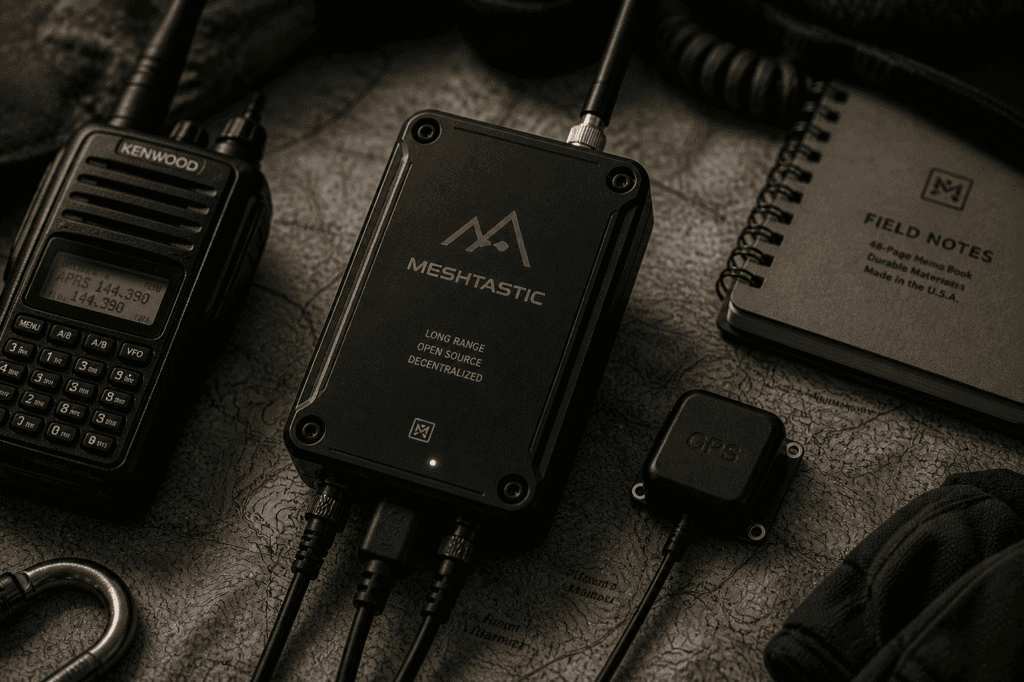
You’re three kilometers into a dense forest during a red team field exercise. Your cellular signal dropped two ridges ago. The team’s last known position is stale. Your commercial GPS tracker is phoning home to a cloud server you don’t control, logging coordinates you’d rather not hand to anyone. And the mesh node you set up at the trailhead? Silent. Because someone forgot to check whether it had GPS onboard, or just assumed it did.
That assumption costs ops. It costs time. Sometimes it costs more than that.
Meshtastic has earned genuine traction in security and tactical communities not because it’s trendy, but because it solves a real problem: encrypted, off-grid, peer-to-peer communication over LoRa that doesn’t depend on infrastructure you don’t own. But the GPS question is where a lot of people get tripped up. Not every Meshtastic node ships with an integrated GPS module. Some require external hardware. Some have it but bury it in fine print. And the difference matters enormously when you’re trying to build a reliable off-grid mesh with real-time position awareness.
This is the part where we sort that out.
Meshtastic’s position-sharing feature is one of its most operationally useful capabilities — but it only works if nodes know where they are. Without an integrated GPS, a node can still relay messages and extend the mesh, but it can’t contribute to the network’s position graph or enable the real-time location tracking that makes mesh comms genuinely situational-aware.
For security researchers and red team operators specifically, that distinction is significant. You’re not just chatting — you’re coordinating movement, tracking asset positions, and in some cases building a rough common operating picture without any external infrastructure. A meshtastic device with integrated GPS tracker functionality closes that loop without requiring you to bolt on a separate module and pray the firmware plays nicely.
There’s also the data sovereignty angle. Most commercial asset trackers — the kind you’d find in an enterprise logistics stack — are reporting to third-party servers by design. That’s fine for tracking pallets. It’s not fine when you’re doing sensitive field work and your position data is sitting in someone else’s cloud. Meshtastic over LoRa, with GPS onboard, gives you a closed-loop system. The data lives on the mesh. Your mesh.
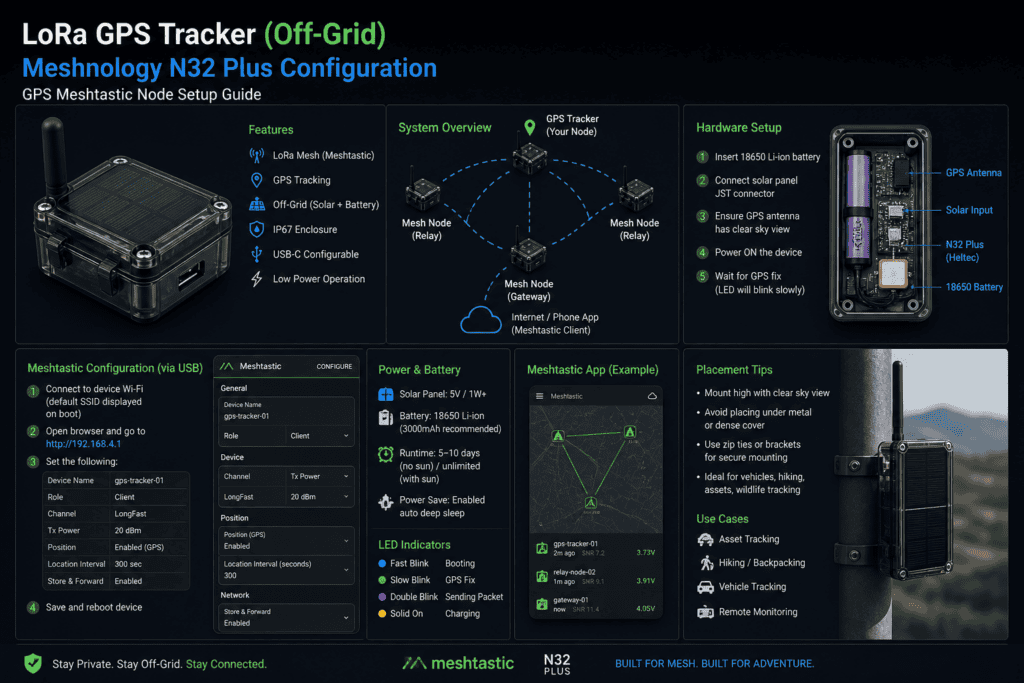
The Meshnology N32 Plus has become a reference point in the community for a reason. It runs on the ESP32-S3 platform, integrates an L76K GPS module, and ships in a form factor that doesn’t feel like a prototype you soldered together on a weekend. The antenna separation is handled properly — LoRa and GPS on distinct antenna paths, which matters more than most people realize when you’re dealing with RF interference in the field.
Meshnology N32 Plus configuration is worth spending time on before you deploy. Out of the box, the GPS update interval is conservative — fine for battery life, less ideal if you need position granularity during active movement. Dropping into the Meshtastic app and adjusting the GPS update rate (under Device Config → Position) from the default to something in the 15–30 second range is the first thing you should do. You’ll burn battery faster, but in a field op context, you’re probably running on a power bank anyway.
The other thing to configure: smart position broadcasting. By default, nodes broadcast position on a fixed interval. Enabling smart position (also in the Position config module) makes the node broadcast only when it detects meaningful movement — preserving bandwidth on a congested mesh and reducing your RF signature if that’s a consideration.
The LILYGO T-Beam is probably the most widely deployed meshtastic device with integrated GPS tracker capability in the field. It pairs a NEO-6M or NEO-M8N GPS module (depending on the revision) with an 18650 battery holder and an SX1276 LoRa radio — everything self-contained, nothing you have to source separately.
It works. The GPS acquisition time on cold start is longer than you’d want — sometimes three to five minutes in challenging conditions — but once it’s locked, it’s reliable. The NEO-M8N variant on the T-Beam Supreme is noticeably better on acquisition, particularly under tree cover where the older NEO-6M struggles.
The frustration with the T-Beam is the power management. The AXP192 power IC has well-documented quirks with certain firmware versions, and if you’ve ever had a T-Beam inexplicably fail to wake from deep sleep, you know exactly what this refers to. It’s solvable — there are community-tested config workarounds — but it’s the kind of thing that bites you once before you learn to account for it.
For a detailed hardware breakdown and supported firmware versions, the official Meshtastic device docs are the most accurate source. Don’t rely on third-party forum posts for pin configs — they go stale fast.
Heltec’s Vision Master T190 is a more recent entry that integrates LoRa, GPS, and a small TFT display in a significantly smaller footprint than the T-Beam. For roles where you need a wearable or easily-pocketable node without sacrificing position capability, it’s a compelling option.
The GPS module here is an L76K — same as the Meshnology N32 Plus — which has decent sensitivity and multi-constellation support (GPS + BeiDou + GLONASS). In dense urban environments or areas where GPS satellite geometry is poor, multi-constellation matters. It’s not a silver bullet, but it’s a meaningful advantage over single-constellation modules.
Display integration is a double-edged thing. It adds utility for standalone operation you can see node count, your position, channel info without pulling out a phone. It also adds another power draw and another failure point. For nodes you’re deploying and leaving (relay nodes at elevation, for instance), the display is mostly irrelevant. For a device you’re actively carrying, it earns its keep.
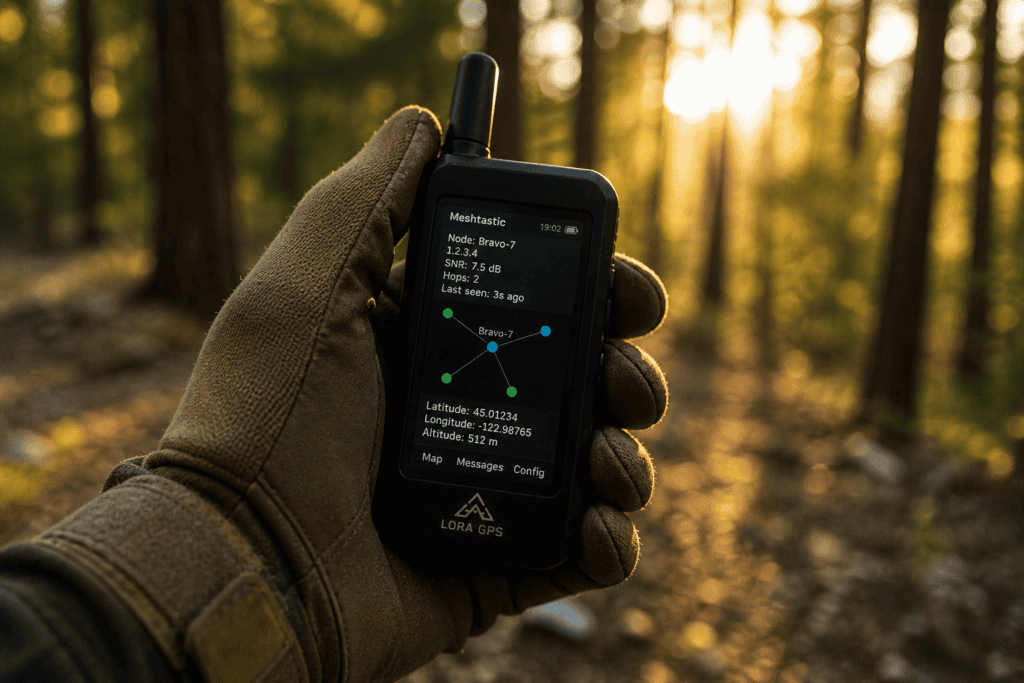
Hardware selection is the easy part. The failure modes usually live in setup and deployment decisions.
First: antenna placement. GPS antennas need sky visibility. That sounds obvious until you’ve watched someone drop a node into a waterproof pelican case with a metal lid and then wonder why GPS acquisition takes fifteen minutes. The ceramic patch antenna on most integrated modules is directional — it wants to face up. If your enclosure forces it sideways, you’re fighting physics. Use a remote GPS antenna with an extension cable if the enclosure demands it.
Second: channel configuration. The default Meshtastic channel (LongFast) is fine for getting started but it’s also what every other Meshtastic node in range is running. For operational use, generate a custom channel with a unique PSK. It takes thirty seconds in the app and it means your mesh isn’t accidentally merging with someone else’s network. Meshtastic’s channel configuration documentation covers PSK generation and channel settings clearly.
Third: the hop count question. Default hop count in Meshtastic is 3. For most deployments this is appropriate. Increasing it extends theoretical reach but also increases the amount of redundant rebroadcasting, which degrades throughput and battery life across the mesh. In a small team deployment — six to ten nodes — dropping hop count to 2 often actually improves performance because you’re reducing unnecessary relay traffic. Test it. Don’t just accept defaults.
Meshtastic uses AES-128 encryption by default on custom channels. That’s not nothing — AES-128 is not broken in any practical sense — but the key management model is worth thinking about. The PSK is shared across all nodes on a channel. If one device is captured or compromised, the entire channel’s traffic history is potentially readable. There’s no forward secrecy. No per-session key negotiation.
For most off-grid comms use cases this is an acceptable trade-off. For operational security in genuinely adversarial environments — which some red team field scenarios approximate — it’s something to have a clear-eyed view of. The threat model matters. Meshtastic was designed for community mesh networking and disaster communications, not for protecting traffic against sophisticated adversaries with direction-finding equipment and the time to work a captured node. Know what it is. It’s still genuinely useful within that frame.
The RF exposure side is also relevant. LoRa transmissions are relatively short-duration and low-power, but in an environment where RF emissions are a concern — think certain red team scenarios where you’d rather not light up a spectrum analyzer — the periodic GPS position broadcasts are detectable. GPS meshtastic node setup with smart position enabled and conservative broadcast intervals helps here, but it doesn’t make you invisible. Nothing does.
The T-Beam with an 18650 at 3000mAh will give you somewhere between 8–20 hours of operation depending on GPS update rate, transmit power, and how chatty the mesh is. The Meshnology N32 Plus is in similar territory. If you need multi-day deployment without power access, you’re either solar-supplementing or running in a low-power relay mode where GPS is disabled.
That’s a real operational constraint. A meshtastic device with integrated GPS tracker module running at full capability is not a set-it-and-forget-it deployment for extended durations without a power strategy. Plan accordingly and plan honestly, not optimistically.
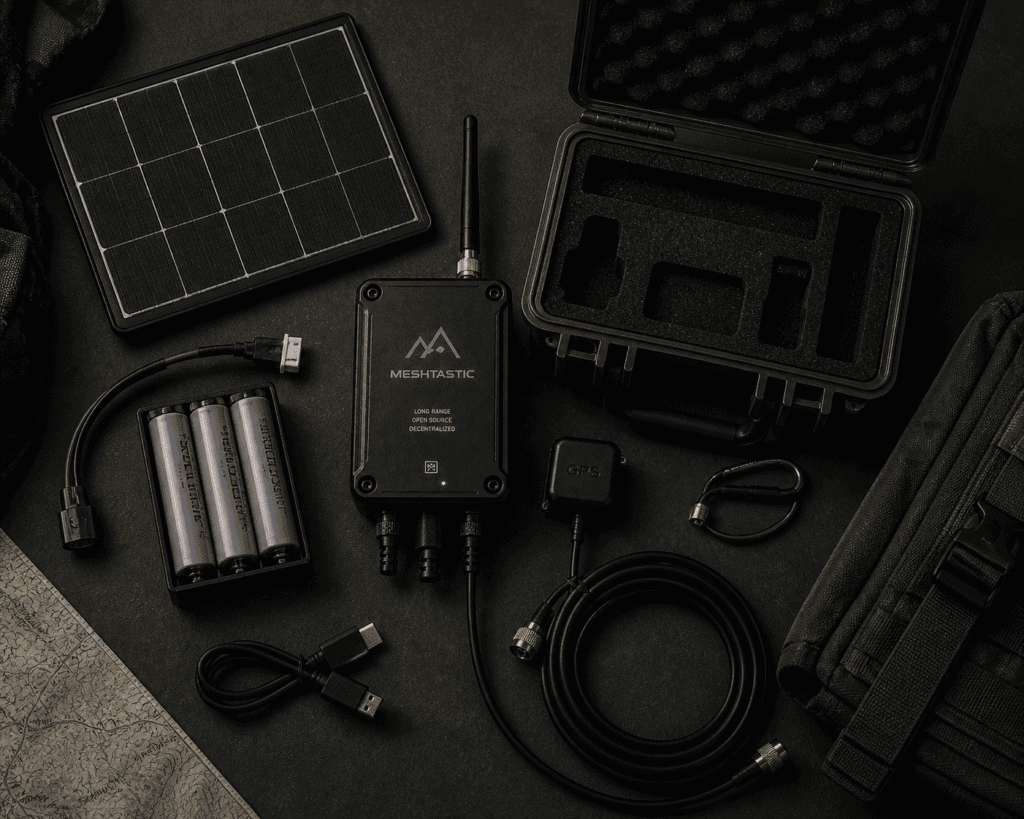
It depends on what you’re optimizing for — but here’s a direct cut at it.
If you want a device that’s ready to deploy with minimal fuss and solid community support, the LILYGO T-Beam Supreme (NEO-M8N variant) is the safe choice. It’s proven, the firmware support is mature, and the ecosystem around it is large enough that you’ll find answers to edge cases quickly.
If you care about form factor, display utility, and multi-constellation GPS, the Heltec Vision Master T190 is worth serious consideration — especially as a carried device rather than a static relay node.
If Meshnology N32 Plus configuration flexibility and build quality matter most — and you’re willing to put in the setup time to get it dialed — the N32 Plus holds its own against anything in this category. The RF design is cleaner than most, and the L76K GPS module performs well under canopy.
None of them are perfect. All of them are useful. The worst outcome is spending three weeks comparing spec sheets and then improvising in the field with hardware you half-understand.
The value of a proper meshtastic device with integrated GPS tracker capability isn’t in the spec sheet — it’s in the operational clarity it provides when infrastructure doesn’t exist or can’t be trusted. These devices exist at an interesting intersection: open-source firmware, commodity LoRa hardware, and a use case that genuinely matters for anyone who operates in environments where commercial networks are unavailable, unreliable, or simply not an option they want to depend on.
The tech is real. The limitations are real. The use case is real. Going in with clear eyes on all three is what separates a useful deployment from an expensive lesson.
If you’re putting together a field kit or looking for the right hardware to build around, see what we carry — the selection runs toward gear that’s actually been thought through for this kind of work.
