You’ve got a Meshtastic node sitting on your desk that can barely punch through two walls. Meanwhile, someone in a Discord thread is claiming 40-kilometer links on a single charge. One of those statements is the result of deliberate setup. The other is vibes.
The gap between a toy LoRa node and a genuinely useful off-grid mesh isn’t mystical. It’s antenna placement, output power, hardware selection, and a bit of RF discipline. The Meshnology N33 kit is one of the more honest attempts at packaging those variables into something deployable and this post is about actually using it outdoors, not just unboxing it.
If you’re reading this, you’re probably building field comms infrastructure for an exercise, hardening a network that survives when the internet doesn’t, or just done with the limitations of nodes that were clearly designed for indoor demos. All valid.
The node isn’t the problem. It rarely is.
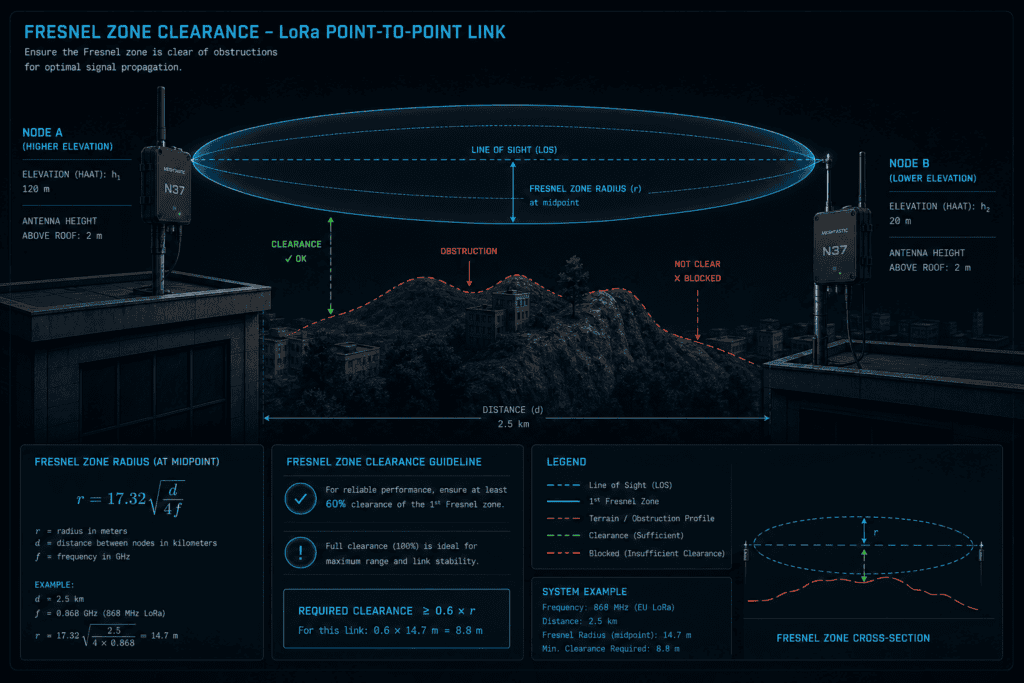
The issue is that most people treat LoRa deployment like they’re extending a Wi-Fi network — throw it near a window, maybe elevate it slightly, call it done. LoRa at 915 MHz (or 868 MHz depending on your region) follows different physics. The Fresnel zone matters. Line-of-sight obstructions that wouldn’t affect Wi-Fi will gut your link budget entirely.
A properly executed high power LoRa outdoor coverage setup starts with a path loss estimate before a single cable gets run. The free-space path loss formula isn’t academic overhead — it tells you whether your link is physically viable before you climb anything.
The Meshnology N33 kit addresses the hardware side of this equation. But hardware alone won’t save a bad site survey.
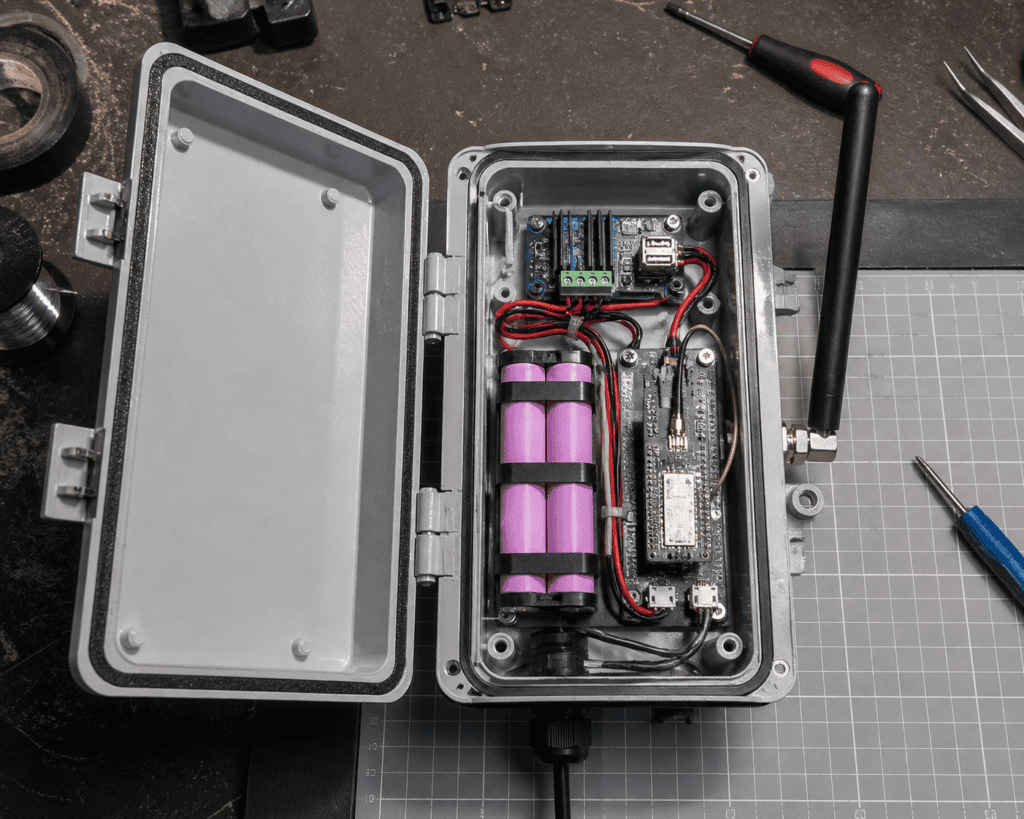
The N33 is built around the Heltec LoRa 32 V3 module — the one with the SX1262 transceiver, which matters because the SX1262 has meaningfully better receiver sensitivity than its predecessors. We’re talking approximately -148 dBm sensitivity at SF12, which is about as good as it gets for consumer LoRa silicon.
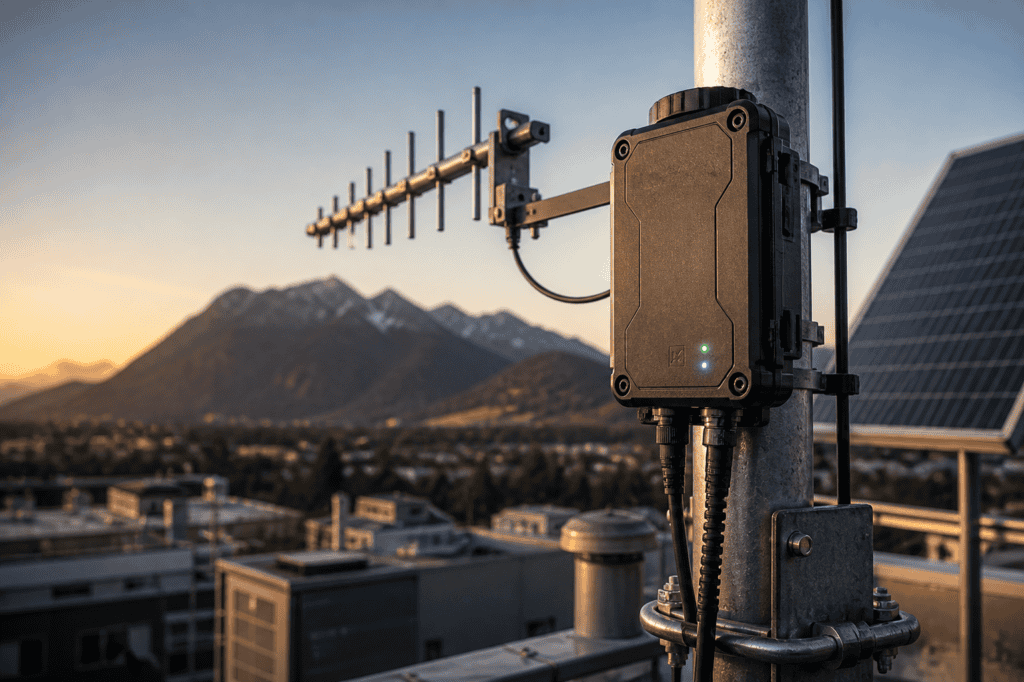
The kit pairs that with an outdoor-rated enclosure, a quality N-type antenna connector, and the assumption that you’re going to mount this thing somewhere exposed. That last part is the real differentiator. Most hobbyist Meshtastic setups use SMA connectors, thin coax, and plastic enclosures rated for nothing. The N33 kit treats weatherproofing like a requirement rather than an afterthought.
For a genuine high power LoRa outdoor coverage setup, this matters more than the chip spec sheet. A -148 dBm receiver behind a leaky connector and a poorly sealed enclosure is a liability, not an asset. Water ingress, oxidation on connectors, and UV degradation on cheap plastic enclosures are the quiet killers of outdoor nodes that nobody writes post-mortems about.
The stock antenna shipped with most Meshtastic kits is fine for proving the concept. For outdoor deployment, it’s a starting point at best.
For omnidirectional coverage — the kind you need if you’re creating a mesh relay node that serves 360 degrees — a fiberglass collinear with 5–6 dBi gain at 915 MHz is the practical sweet spot. Go higher than 6 dBi and you start compressing the vertical radiation pattern so aggressively that nodes on hills above or below your elevation drop out.
For point-to-point links — two fixed nodes, known bearings, maximum distance — a Yagi or directional panel antenna changes the math entirely. A 9–12 dBi directional effectively doubles your effective range on that specific link compared to an omnidirectional. The tradeoff is obvious: it only serves that one direction.
The N33 kit’s N-type connector means you’re not fighting adapter losses. Run quality LMR-400 (or equivalent low-loss coax) if your antenna needs to be more than a meter from the enclosure. Every meter of RG-58 at 915 MHz costs you roughly 0.5 dB. At distance, that adds up faster than you think.
Setup is straightforward if you’ve flashed Meshtastic firmware before. The N33 uses USB-C for initial flashing, and the Meshtastic documentation covers the firmware side adequately. What the docs don’t cover is the operational discipline required for a real outdoor deployment.
Power budget first. The N33 running at maximum TX power (up to +22 dBm on the SX1262) will drain a standard 18650 Li-ion in hours if it’s transmitting frequently. For a meshtastic outdoor node kit deployment that needs to run unattended, solar charging paired with a 3000–5000 mAh cell is the minimum viable setup in most climates. In northern latitudes during winter, do the math on available solar hours before you commit to a panel size. A node that dies at midnight in week two of your exercise is worse than no node.
Channel configuration matters for security — not just range. Meshtastic’s default channel uses AES256-CTR encryption with a hardcoded key that approximately every Meshtastic device on the planet shares by default. If you’re deploying for operational use rather than just testing, generate a custom PSK and push it to all nodes in your mesh before deployment. This is basic OPSEC but it gets skipped constantly.
Real-world long range LoRa outdoor performance is consistently humbling when you haven’t done it before, and consistently impressive when you have. The difference is expectation calibration.
In flat terrain with clear line-of-sight, SF12 bandwidth 125 kHz, +20 dBm TX, and a modest 3 dBi antenna on each end — expect 10–20 km reliably. Elevate one node to a rooftop or hilltop and that number climbs fast. The Semtech LoRa range estimator is worth running before a deployment to sanity-check your link budget against terrain.
A Meshnology N33 outdoor range test run in semi-rural terrain with modest elevation — one node at a 3-story building rooftop, one node mobile at ground level — should comfortably demonstrate 8–15 km range depending on foliage density and whether you’re chasing NLOS paths through neighborhoods. With genuine hilltop-to-hilltop line of sight and proper antenna selection, the hardware ceiling is well above that.
SF12 isn’t always the right choice, incidentally. It gives you the best sensitivity but the slowest data rate and the highest airtime per packet. If you’re in a dense mesh with many nodes, higher spreading factors create more congestion. SF10 or SF9 might serve a high power LoRa outdoor coverage setup better in practice if your link budget allows it.
A sealed enclosure that opens every time it rains because someone didn’t run the cable entry properly isn’t sealed. Use proper IP68-rated cable glands for any cable penetrations. Self-amalgamating tape over N-type connectors and any exposed coax joints. Orient your enclosure with the cable entry facing down where possible.
UV degradation is slower but equally fatal. If your enclosure is black ABS in direct sun, surface temperatures can hit 60–70°C in summer. Most LoRa modules have absolute maximum ratings in that range. The N33 enclosure accounts for this — but any accessories or secondary boxes you add should be checked.
Lightning protection is the topic everyone ignores until it isn’t. If you’re mounting an antenna on a rooftop or any elevated structure, a proper surge arrestor between the antenna and the enclosure is not optional. The SX1262 will not survive a nearby strike without one. Gas discharge tube arrestors rated for the 868/915 MHz band are cheap relative to replacing hardware.
Meshtastic is increasingly showing up in red team field exercises, disaster response coordination, and off-grid operational scenarios where cellular infrastructure is unavailable or untrusted. That’s the right use case for this hardware.
It also means your mesh nodes are RF-emitting devices in the field. They’re detectable with an SDR running a LoRa demodulator. The LoRa preamble is identifiable even without decrypting the payload. If your operational scenario requires RF silence, Meshtastic nodes need to be off, not just quiet. There’s no low-power beacon mode that makes them invisible.
The MITRE ATT&CK framework doesn’t have a LoRa-specific technique yet, but the RF intelligence gathering and protocol-specific interception TTPs are well-established in adjacent domains. Know what your mesh is visible as, even when your traffic is encrypted.
For legitimate red team field comms — coordinating team movement, passing target data in a no-cell-service environment — a properly configured high power LoRa outdoor coverage setup with custom PSKs and minimal TX power (use the minimum that maintains link quality, not the maximum because it’s available) is a genuinely useful capability. Just treat it like any other emissions-producing device in your operational footprint.

Before you finalize a node location, run a path profile between your planned node positions using terrain data. Tools like HeyWhatsThat or RadioMobile are free and will save you a wasted deployment. Confirm Fresnel zone clearance at your operating frequency, not just visual line of sight.
Set TX power to the minimum needed for your target link margin — typically 10–15 dB above the receiver sensitivity floor. Running maximum power constantly wastes battery, increases interference to other LoRa users sharing the band, and provides zero benefit once you’re above your fade margin.
Document your node locations, antenna orientations, and channel configuration. It sounds obvious. Operational nodes six months after deployment with no documentation are a real problem when you’re troubleshooting at 2am.
Test before you need it. A meshtastic outdoor node kit that gets deployed for the first time on the day of an exercise is a liability. Range test under realistic conditions, verify mesh routing behavior with the expected number of nodes, and confirm your power system sustains the node through a full simulated deployment cycle.
The Meshnology N33 kit isn’t solving a problem that didn’t exist before it — it’s packaging the right solution to a problem that a lot of people were solving badly. Weather-rated enclosures, quality RF connectors, capable silicon. The gap between a well-deployed N33 and a poorly deployed one is entirely operator-side: site selection, antenna choice, power planning, and channel configuration.
Done right, a high power LoRa outdoor coverage setup built on this hardware gives you genuinely useful off-grid mesh infrastructure. The kind that works when cell towers are congested, down, or deliberately avoided. For field exercises, operational deployments, or just building resilient comms that aren’t dependent on someone else’s infrastructure — the hardware is there. The rest is execution.
If you’re putting together the full kit for a deployment, see what we carry the N33 and supporting hardware are stocked alongside the other tools that serious practitioners actually reach for.
