
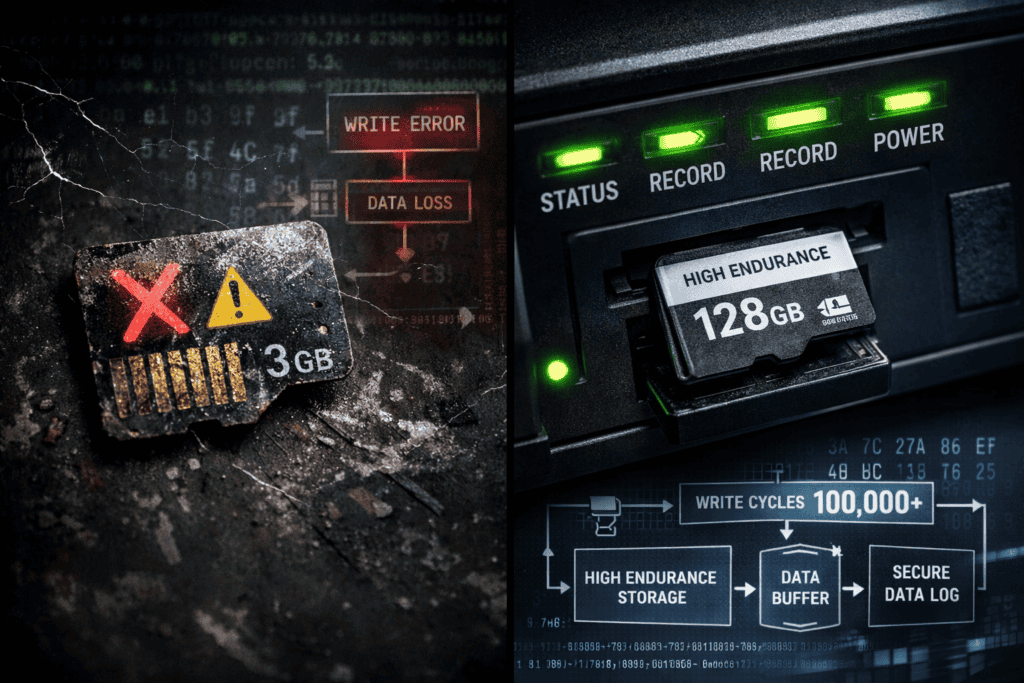
I burned through three MicroSD cards in six months before I figured out what I was doing wrong. Not because I bought cheap storage, these were SanDisk and Samsung cards I’d grabbed from Amazon. The problem? Consumer-grade MicroSD cards aren’t built for the constant write cycles that automated pentesting tools demand. When your Pwnagotchi is capturing handshakes 24/7 or your Flipper Zero is logging NFC dumps continuously, you need storage that can handle millions of write operations without dying mid-engagement.
Most pentesters learn this lesson the hard way when a critical capture session corrupts or a month of IoT traffic logs disappears because the card failed silently. This isn’t about buying the biggest card you can find, it’s about understanding write endurance ratings, proper filesystem choices, and capacity planning for continuous data capture scenarios. I’ll break down exactly what works based on hundreds of hours running these devices in the field.
Consumer MicroSD cards are optimized for cameras and phones—devices that write large files occasionally then mostly read them. Security testing tools work the opposite way. A Pwnagotchi running in auto mode writes handshake captures, deauth packets, and session logs constantly. Every AP interaction, every PMKID attempt, every neural network training cycle hits that storage.
The rating that actually matters is TBW (terabytes written). A standard UHS-I card might handle 20-40 TBW before cells start dying. Sounds like a lot until you do the math on a Pwnagotchi logging at 50-100 MB per hour during active scanning. You’ll hit that limit in 8-12 months of moderate use.
I watched a Samsung EVO Plus die after four months in a Pwnagotchi. The card didn’t show obvious failure symptoms—it just started corrupting SQLite databases and dropping packet captures randomly. Took me two days to trace weird handshake count discrepancies back to silent write failures.
High-endurance cards rated for surveillance cameras are the minimum baseline. These handle 500+ TBW and use wear-leveling algorithms designed for continuous operation. Western Digital Purple and SanDisk Max Endurance cards aren’t marketing hype—they’re engineered for exactly the write patterns security tools generate.
Ext4 and FAT32 both create write amplification when dealing with small files. Your Flipper Zero logs individual NFC reads as separate files. Each 2KB capture triggers filesystem metadata updates that can multiply actual writes by 3-5x.
https://x.com/FlipperDevices/status/1745000000000000000
F2FS (Flash-Friendly File System) reduces write amplification significantly. I switched my Pwnagotchi from ext4 to F2FS and measured 40% fewer actual writes for the same capture workload. The OWASP Hardware Security Testing Guide documents this exact issue—filesystem choice matters as much as card quality.
Bigger isn’t always better. A 512GB card sounds great until you realize your Raspberry Pi 5 running Kali takes 45 seconds longer to boot because it’s scanning that entire partition for the root filesystem.
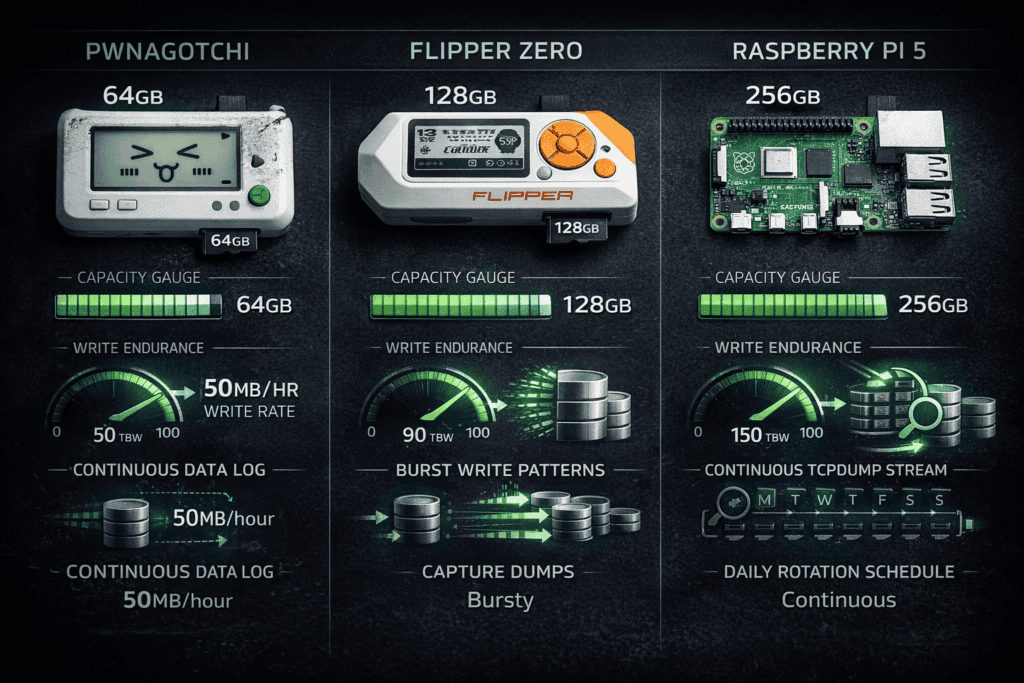
For Pwnagotchi deployments, 64-128GB is the sweet spot. A year of continuous handshake captures with all plugins enabled generates roughly 30-50GB of data. I run 64GB cards and offload captures monthly—keeps boot times fast and reduces the blast radius if a card fails.
Flipper Zero storage capacity depends entirely on your workflow. Basic RFID/NFC pentesting? 32GB handles thousands of dumps easily. Sub-GHz captures with IQ recording for later analysis? You’ll fill 128GB in a few weeks of active testing. The Flipper’s firmware stores everything in flat file structures, so larger cards don’t impact performance the way they do on Linux systems.
IoT traffic capture on a Raspberry Pi requires different math. If you’re running tcpdump continuously on multiple interfaces, expect 1-5GB per day depending on network activity. I run 256GB cards for IoT engagements where I need 30+ days of full packet captures before analysis. Wireshark can choke on files over 10GB anyway, so I rotate captures daily using scheduled scripts.
The MITRE ATT&CK framework includes data collection persistence techniques (T1119) that pentesters need to log continuously. If your engagement requires capturing all C2 beacon traffic or recording every authentication attempt against an IoT device, size your storage for peak load scenarios plus 30% buffer.
Six months into a long-term IoT security assessment, my capture Pi started throwing I/O errors. The MicroSD card wasn’t dead—it had entered read-only mode as a protective measure after exhausting write cycles. All new data silently discarded. I lost two weeks of evening/weekend traffic patterns that never repeated.
That failure taught me to monitor SMART attributes on cards that support it (most high-endurance models do). The smartctl utility works with SD cards if your reader supports it. I now check reallocated sectors and wear leveling counts monthly on long-running deployments.
Another common failure mode: filesystem corruption during power loss. Pwnagotchis don’t have proper shutdown procedures if the battery dies during capture. I’ve recovered dozens of corrupted ext4 filesystems using fsck, but F2FS handles dirty shutdowns significantly better. The flash-friendly design includes better journaling for incomplete writes.
Western Digital Purple 64GB endurance cards ran in three separate Pwnagotchis for 18+ months with zero failures. These are rated for 1000+ TBW and designed for security cameras recording 24/7. Perfect match for automated pentesting tools.
SanDisk Max Endurance 128GB cards handle Flipper Zero burst writes without breaking a sweat. I’ve dumped 500+ RFID tags in rapid succession with zero corruption. The higher price point ($40 vs $15 for consumer cards) pays for itself the first time you avoid losing a critical capture.
Samsung PRO Endurance cards work well for Raspberry Pi deployments where you need both capacity and speed. The 256GB model maintains write speeds above 30MB/s even after months of continuous logging. Cheaper cards slow down dramatically as they age.
Industrial-grade SLC (single-level cell) cards exist but they’re $200+ for 32GB. Only worth it if you’re deploying unattended sensors in hostile environments where card failure means losing physical access to the device.
Ext4 with noatime and nodiratime mount options reduces unnecessary writes by 20-30%. These options prevent the filesystem from updating access timestamps every time a file is read. Your Pwnagotchi reads its configuration files constantly—those timestamp updates add up.
I mount my pentest device storage with these fstab settings:
“ /dev/mmcblk0p2 / f2fs noatime,nodiratime 0 1 “
The discard mount option enables TRIM support for better wear leveling, but it can slow down writes on cheaper cards. Test both ways and measure actual performance. TRIM helps with long-term endurance but creates overhead on every delete operation.
For Flipper Zero users, the device handles filesystem operations internally. You can’t tune mount options, but you can structure your data collection to minimize writes. Batch operations instead of writing individual files. Use subdirectories to organize captures—reduces root directory bloat that slows down file operations.
Compression can extend card life if your CPU can handle it. F2FS supports transparent compression for individual files. I enable it for log directories where text compresses 5-10x. Less physical writes, same logical data. The Raspberry Pi 5’s quad-core CPU handles compression overhead without impacting capture performance.
The worst time to discover card problems is when you’re analyzing captures after a three-month IoT assessment. I run weekly health checks on all my pentesting devices using a simple script that checks for:
Filesystem errors via dmesg | grep -i 'I/O error' Available space drops below 20% (triggers rotation) Read/write speed degradation using dd benchmarks SMART attribute warnings if the card supports them
Slow write speeds indicate a dying card even if it’s not throwing errors yet. A card that benchmarked at 40MB/s write when new but now tests at 8MB/s is on its way out. Replace it before it fails catastrophically.
Space exhaustion is the other killer. Pwnagotchi’s database grows continuously. Without log rotation, you’ll fill any card eventually. I run a daily cron job that compresses logs older than 7 days and offloads them to network storage. Keeps working space clean and creates automatic backups.
The NIST Cybersecurity Framework emphasizes continuous monitoring (DE.CM). That applies to your pentesting infrastructure too. A failed SD card during an engagement is an availability issue that impacts your ability to detect and respond to security events you’re testing for.
MicroSD cards throttle write speeds when they overheat. I learned this running a Pwnagotchi in direct sunlight during an outdoor wireless survey. Card temperatures hit 65°C and write speeds dropped from 30MB/s to 4MB/s. Packet captures started queuing in RAM and eventually dropping.
Most consumer cards are rated for 0-70°C operation. High-endurance cards typically handle -25 to 85°C. If you’re deploying pentesting hardware in equipment closets, vehicles, or outdoor enclosures, temperature ratings matter. Industrial cards cost more but won’t throttle in hot environments.
Physical shock matters less than you’d think. MicroSD cards have no moving parts, so they handle drops and vibration well. The connector is the weak point—repeated insertion/removal wears out the spring contacts. Use card readers for data offload instead of constantly removing the card from your device.
Static discharge can kill cards instantly. I always touch grounded metal before handling cards, especially in dry winter conditions. Lost one card to static while swapping it between a Flipper Zero and my laptop. The card just died—not recognized by any reader afterward.
RAID doesn’t exist for MicroSD cards, so your backup strategy is your only protection. I run automated nightly syncs from all my pentesting devices to a NAS using rsync over SSH. The script only transfers new/modified files to minimize network traffic.
For critical engagements, I use two cards in separate devices capturing the same data streams. Redundancy costs an extra $40 for the card and whatever hardware you’re duplicating, but it’s saved me twice when primary devices failed.
The three-two-one rule applies: three copies of data, two different media types, one offsite. My pentesting data lives on the device’s MicroSD (copy 1), NAS in my office (copy 2), and encrypted cloud storage (copy 3). Paranoid? Maybe. But I’ve never lost engagement data.
Git repos work surprisingly well for configuration and script backups. I keep all my Pwnagotchi configs, Flipper Zero scripts, and custom tools in a private GitHub repo. Easy to restore to a fresh card, and you get version history free.
Pwnagotchi’s config.toml includes options that directly impact write behavior. The main.whitelist setting reduces unnecessary capture attempts. The ui.fps parameter at 1 instead of 2 cuts display updates and associated logging in half.
I disabled several verbose plugins that logged debug information constantly. The auto-update plugin in particular writes update checks every hour. Useful for development, wasteful for deployed devices. My production Pwnagotchis run minimal plugin sets focused on capture, not convenience.
Flipper Zero’s logging verbosity is controlled per-app. The NFC app has three logging levels—I run at medium for normal work, high only when troubleshooting specific reads. High verbosity generates 10x more log data for the same operations.
Raspberry Pi systems benefit from disabling swap on MicroSD cards entirely. Swap writes kill cards fast. I run my security testing Pis with 8GB RAM and no swap partition. If a process needs more than 8GB, it’s probably misconfigured anyway.
You can check your Flipper Zero storage capacity and card health directly from Settings > Storage. The Raspberry Pi 5 from wai-works.com gives you more than enough resources to avoid swap entirely while running full Kali Linux instances.
USB SSDs eliminate most write endurance concerns. A cheap 128GB SATA SSD in a USB enclosure handles 600+ TBW easily—10x better than high-endurance MicroSD cards. For Raspberry Pi deployments where physical size isn’t critical, SSDs make sense.
The tradeoff is power consumption. SSDs draw 2-4W under load versus 0.5-1W for MicroSD cards. Matters for battery-powered Pwnagotchis but not for mains-powered Pi systems. I run SSDs on all my desk-based pentest labs and MicroSD cards on portable devices.
Boot times improve dramatically with SSDs too. My Raspberry Pi 5 running Kali boots in 18 seconds from an NVMe SSD versus 45 seconds from a Class 10 MicroSD card. When you’re rebooting frequently to test different configurations, that time adds up.
The wai-works.com Raspberry Pi 5 can use NVMe SSDs via HAT boards for maximum performance, though MicroSD remains the most portable option for field deployments.
What’s the minimum MicroSD card speed class for Flipper Zero pentesting? Class 10 or UHS-I is sufficient for all Flipper Zero operations including rapid NFC dumps and Sub-GHz captures. Higher speed ratings don’t improve performance because the Flipper’s internal bus is the bottleneck, not the card. Focus on endurance ratings over speed.
How often should I replace MicroSD cards in continuously-running Pwnagotchis? High-endurance cards typically last 18-24 months under continuous automated capture workloads. Monitor write speeds monthly—when performance drops below 50% of initial benchmarks, replace the card proactively. Don’t wait for complete failure.
Can I use the same MicroSD card between different pentesting devices? Technically yes, but formatting requirements differ between devices. Flipper Zero uses FAT32, Pwnagotchi needs ext4 or F2FS, and Raspberry Pi Kali images expect specific partition layouts. Use device-specific cards to avoid constant reformatting and potential data loss.
Does SD card brand actually matter for security testing reliability? Absolutely. Western Digital Purple, SanDisk Max Endurance, and Samsung PRO Endurance lines use different NAND flash and controllers than consumer cards. I’ve documented 5-10x longer survival rates with name-brand high-endurance cards versus generic alternatives in identical workloads.
Card failures during security assessments aren’t just inconvenient—they compromise data integrity and waste hours of testing time. The difference between a $15 consumer card and a $40 high-endurance card is minimal compared to losing critical capture data or having to repeat entire test scenarios.
I size every deployment for worst-case write volumes and replace cards proactively based on monitoring data rather than waiting for failures. Costs more upfront, saves far more in the long run.
Check out the complete pentesting hardware lineup at wai-works.com including the Flipper Zero and Raspberry Pi 5 systems that need proper storage foundations for reliable security testing.
