
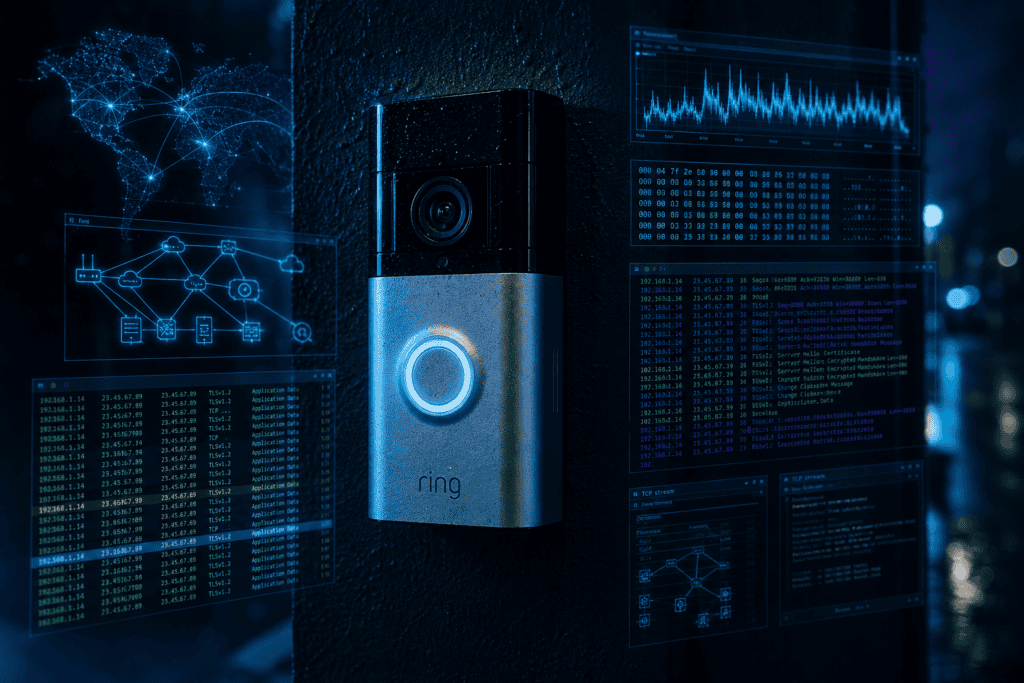
You Already Own the Lab Target Ring doorbells are in millions of homes. They’re on corporate campuses, apartment buildings, and small business storefronts. They’re trusted implicitly, handed network credentials, given cloud access, and left to do their thing with essentially zero post-installation scrutiny.
That makes them a perfect IoT security testing doorbell platform. Not because they’re uniquely broken, but because they’re representative. Same firmware update cadences as half the consumer IoT market. Same cloud-relay architecture. Same tension between usability and security that defines the entire category.
This guide assumes you’ve got a Ring device you own outright, legally and ethically important, a dedicated lab network, and enough patience to do this properly. We’re not here to brick someone’s front door camera. We’re here to understand how this class of device behaves under scrutiny.
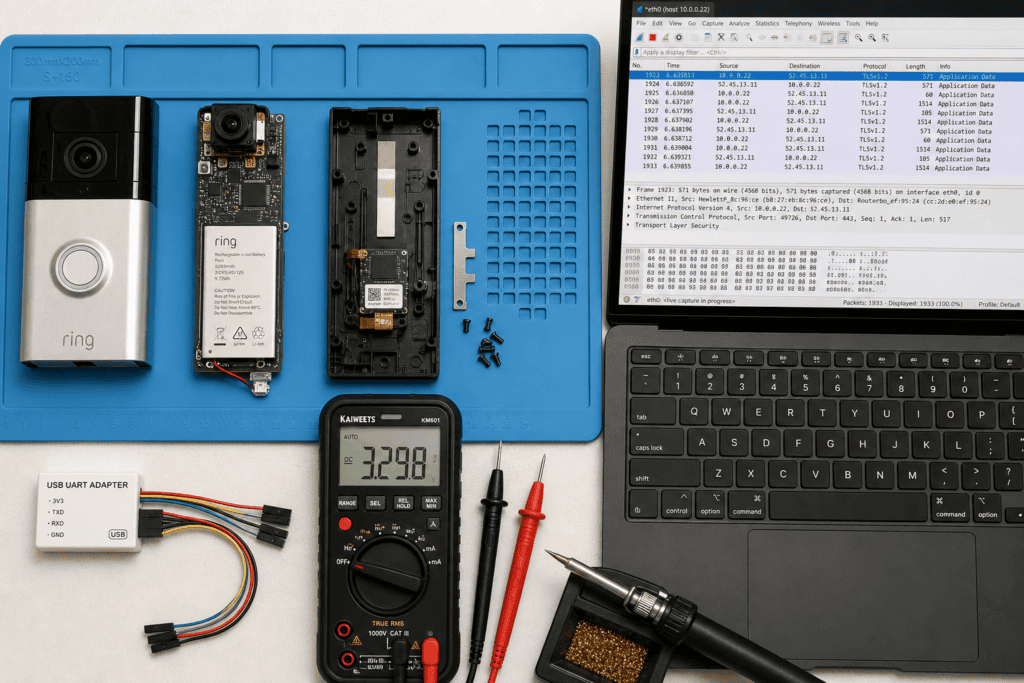
Seriously. Don’t plug this into your main network and call it a lab. IoT testing on a production network is how you create problems you weren’t looking for.
Stand up a dedicated VLAN or use a travel router (GL.iNet devices are popular for this). You want full control over DNS, the ability to ARP spoof without collateral damage, and a clean capture surface. A Raspberry Pi running hostapd as a rogue AP works well for this, the device connects to your controlled AP, you see everything.
The goal for your ring doorbell pentesting lab setup is network isolation plus visibility. Specifically:
Once the device is provisioned through the Ring app on your isolated network, the first thing to do is watch. Just watch. The DNS queries in the first ten minutes of boot will tell you more than most people expect.
Ring devices aren’t standalone. They’re endpoints in a cloud-relay architecture, the device talks to Ring’s AWS infrastructure, the app talks to Ring’s AWS infrastructure, and local network communication between the app and the device is either absent or severely limited depending on the firmware version. That’s the first interesting constraint.
The primary attack surface breaks into a few distinct areas:
The provisioning process, where the device gets your Wi-Fi credentials, has historically been a target. Ring has patched several issues here over the years, but the provisioning window is still worth examining. During setup, some firmware versions broadcast a softAP that accepts credentials with minimal authentication. That window closes, but if you catch it in your controlled lab environment, it’s instructive.
Post-provisioning, the device will beacon out regularly. Check for unencrypted UDP traffic, MDNS announcements, and SSDP. Ring devices have been observed making mDNS queries that disclose device identifiers, not catastrophic in isolation, but useful for fingerprinting in a broader attack chain.
This is where it gets more interesting, and more frustrating. Modern Ring firmware uses TLS with certificate pinning for its cloud communication. You’re not going to MitM that cleanly with Burp’s default CA. If you want to inspect the API traffic, you’re looking at either finding a firmware version without pinning enforcement, extracting the cert from the firmware itself, or working at a lower layer.
MITRE ATT&CK‘s coverage of network sniffing (T1040) is relevant context here, the technique is well understood, but modern TLS implementations in consumer IoT are genuinely getting harder to intercept. That’s progress, even if it’s inconvenient for researchers.
That said, DNS is still cleartext. You’ll see every domain the device touches. Ring’s infrastructure footprint is substantial: AWS endpoints, Akamai CDN, analytics endpoints, third-party integrations. Map all of it.
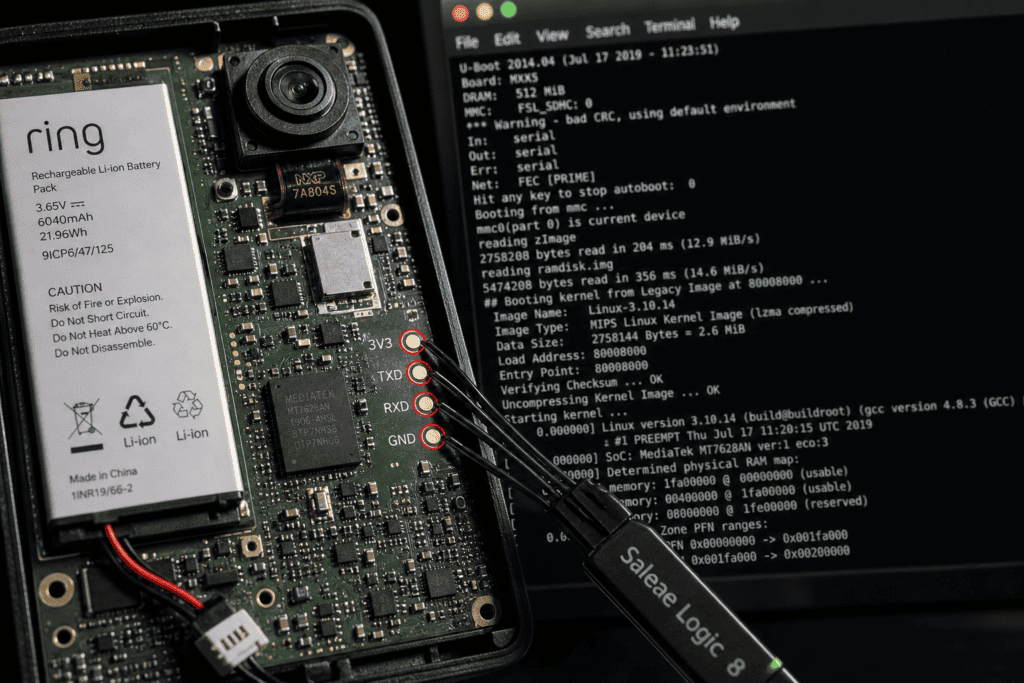
If you’re serious about smart doorbell vulnerability research, you want the firmware. Ring devices use Amazon’s hardened Linux environment and firmware extraction isn’t trivial, the UART interface is present on the PCB but may require soldering to test pads. Binwalk is your starting point; expect a squashfs root with a lot of locked-down configurations, but the filesystem analysis alone can surface hardcoded strings, certificate material, and binary endpoints that aren’t obvious from network traffic.
A 2022 NIST SP 800-213 IoT device cybersecurity guidance document noted that most consumer IoT devices fail to implement firmware update integrity verification in a way that prevents downgrade attacks. Worth testing whether your Ring target will accept an older, potentially less-hardened firmware image.
This isn’t theoretical. Ring has had documented vulnerabilities that map directly to the techniques above.
In 2019, researchers at Bitdefender identified a vulnerability in the Ring Video Doorbell Pro that allowed local network attackers to intercept Wi-Fi credentials during the provisioning process, the device sent credentials in cleartext over its softAP before the handshake completed. Ring patched it, but the disclosure illustrated exactly why the provisioning window deserves scrutiny in any IoT security testing doorbell engagement.
In 2020, a broader series of Ring issues surfaced around account security and the Ring app, credential stuffing leading to unauthorized access to live camera feeds. The Verizon 2023 DBIR noted that credential-based attacks remain the dominant vector for web application breaches at 86%. Ring’s account infrastructure is a web application. The math isn’t complicated.
More recently, the FTC reached a settlement with Ring in 2023 requiring data deletion and security improvements after findings that employees had access to customer video streams. The security model isn’t just the device, it’s the entire trust chain including the vendor.
That’s a useful framing for your lab work. You’re not just testing smart doorbell vulnerabilities at the hardware level. You’re testing an ecosystem.
Run the device for 24 hours before touching anything. Let it go through its normal motion-detection, cloud sync, and update check cycles. Collect all DNS queries, all IP destinations, all connection timing patterns. This baseline matters, anomalies only mean something relative to normal behavior.
Shodan won’t help you here directly, the device isn’t internet-facing in the traditional sense, but querying Shodan for Ring infrastructure endpoints can give you a broader picture of the cloud surface you’re indirectly interacting with.
For active IoT security testing doorbell work, focus on:
The local API, if present, is worth spending real time on. A local endpoint that bypasses cloud authentication would be a significant finding, and the Ring line has had iterations where local control features were added without equivalent security review applied to the cloud-facing components.
UART extraction requires identifying the correct pads, using a logic analyzer to confirm baud rate (115200 is common), and connecting without destroying the device. If you get a shell, you’re looking for: world-readable credential files, running services bound to localhost, and the update mechanism. A device that pulls updates over HTTP, or doesn’t verify signatures, is a device that can be made to run arbitrary code.
This is real how to test IoT device security work, not simulated, not CTF-abstracted. The lessons from a single device like this generalize directly to security camera systems, smart locks, access control panels, and industrial IoT endpoints that share the same architectural assumptions.
{IMAGE PROMPT: Split-screen composition: left side shows a terminal running Wireshark with Ring device network traffic highlighted, right side shows a Kali Linux environment with Burp Suite intercept proxy showing intercepted HTTPS requests. Dark theme throughout, glowing text, professional security research workstation aesthetic.}
If you find something real during your ring doorbell pentesting lab work, and statistically, if you dig long enough, you will, Ring has a vulnerability disclosure program through HackerOne. Document everything: reproduction steps, impact assessment, affected firmware versions. Don’t publish before coordinating.
The IoT security research community is genuinely moving the needle on consumer device security, but only because researchers are doing the work responsibly enough that vendors stay willing to engage. That relationship is worth preserving.
Here’s the uncomfortable truth about IoT security testing doorbell research: the findings rarely stay contained to the device. A compromised Ring doorbell in an enterprise context isn’t a physical security problem, it’s a network foothold. It’s credential exposure. It’s a pivot point.
The 2021 Verkada breach, where attackers accessed over 150,000 security cameras including those inside hospitals, prisons, and Tesla factories, wasn’t primarily a hardware vulnerability. It was credential reuse plus an exposed admin account. The cameras were the visibility; the entry was trivially mundane.
That’s why this kind of lab work matters beyond the specific device. You’re building intuition about a class of targets that’s proliferating faster than defenders can inventory, let alone monitor. Every enterprise network has IoT devices that security teams don’t fully understand. Ring is an accessible, well-documented entry point into that problem space.
Do the work. Build the lab. Read the firmware. Map the traffic. And if you want to go deeper on the hardware and tooling side, the right equipment makes a real difference in what you’re able to find, see what we carry.
