
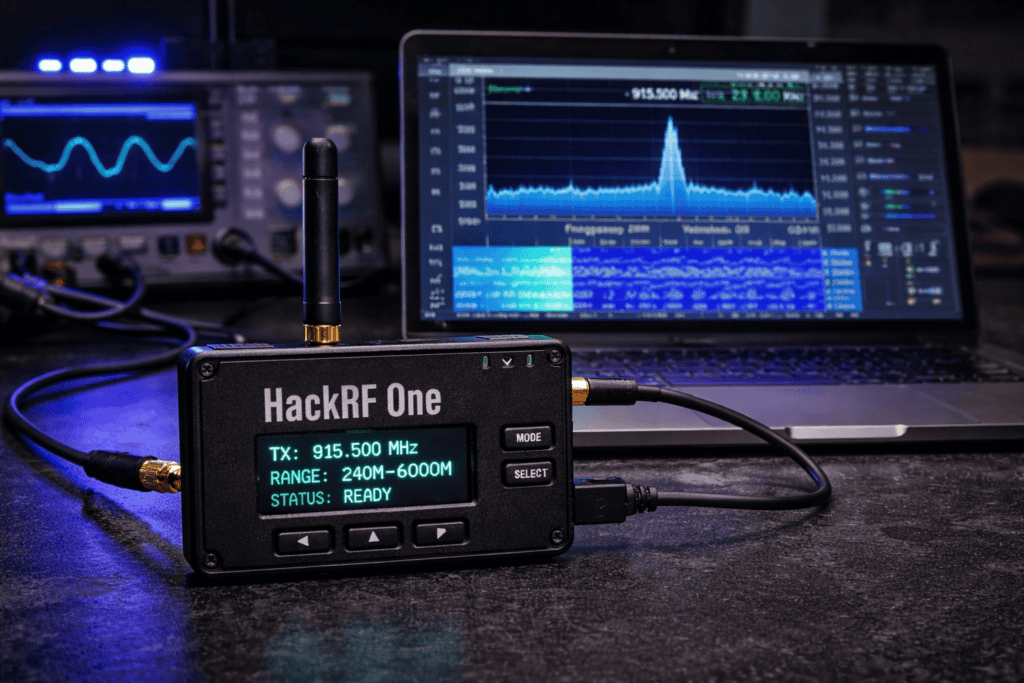
The HackRF One has been sitting in hardware arsenals since 2014. That’s ancient in SDR years — and yet here we are, still talking about it.
Most reviews will give you the spec sheet. MHz this, MSPS that. This isn’t that. If you’re reading this, you already know what software defined radio is. You’ve probably already looked at the official specifications. What you actually want to know is whether the HackRF One still deserves a spot on your bench in 2026, or if it’s just legacy hardware coasting on name recognition.
Fair question.
The HackRF One is a half-duplex transceiver covering 1 MHz to 6 GHz. Eight-bit quadrature sampling at up to 20 MSPS. USB 2.0. Open source firmware and hardware. No built-in amplifier worth mentioning, so factor in an external LNA or PA if you’re doing anything serious.
It’s not the fastest SDR. It’s not the cleanest. It won’t replace a spectrum analyzer or a USRP. But it does something most alternatives don’t: it transmits across a stupidly wide frequency range for under five hundred dollars.
That’s the entire value proposition.

RF reconnaissance. Wireless protocol research. Anything where you need to see what’s happening across a chunk of spectrum without spending four figures on a dedicated tool.
The HackRF One sdr handles receive work cleanly enough for most research scenarios. You’re not getting lab-grade dynamic range, but for identifying signals, reverse engineering protocols, or hunting down mystery transmissions in the sub-6 GHz range, it does the job. Pair it with GNU Radio or SDR# and you’ve got a functional signals intelligence platform.
Transmit is where things get interesting — and messy. The HackRF can replay attacks, test wireless implementations, or simulate threat scenarios across everything from ISM bands to LTE. But the output is noisy. Harmonics leak. If you’re testing in a controlled environment, fine. If you’re trying to do precision work or avoid splatter across adjacent channels, you’ll need filtering and external amplification.
It’s a research tool, not a piece of test equipment.
Calibration drift. The HackRF One uses a cheap TCXO that wanders with temperature. You’ll see frequency drift during longer captures — sometimes enough to matter. There are third-party TCXO upgrades available, but now you’re adding cost and effort to a platform that’s supposed to be plug-and-play.
USB 2.0 is the other constraint. Twenty megasamples per second sounds fine until you’re trying to capture wideband signals and realizing you’re bandwidth-limited by a fifteen-year-old bus standard. The newer SDRs — PlutoSDR, LimeSDR, even the RTL-SDR Blog V4 in receive mode — don’t have this problem.
But they also don’t transmit like the HackRF does.
GNU Radio support is solid. URH (Universal Radio Hacker) works. Most major SDR frameworks recognize it. Community support is mature because the platform’s been around long enough for people to hit every edge case twice.
The learning curve is real if you’re new to SDR, but that’s not the HackRF’s fault. Software defined radio in general requires understanding DSP concepts that most security work doesn’t touch. If you’re coming from traditional pentesting, expect to spend time in documentation.
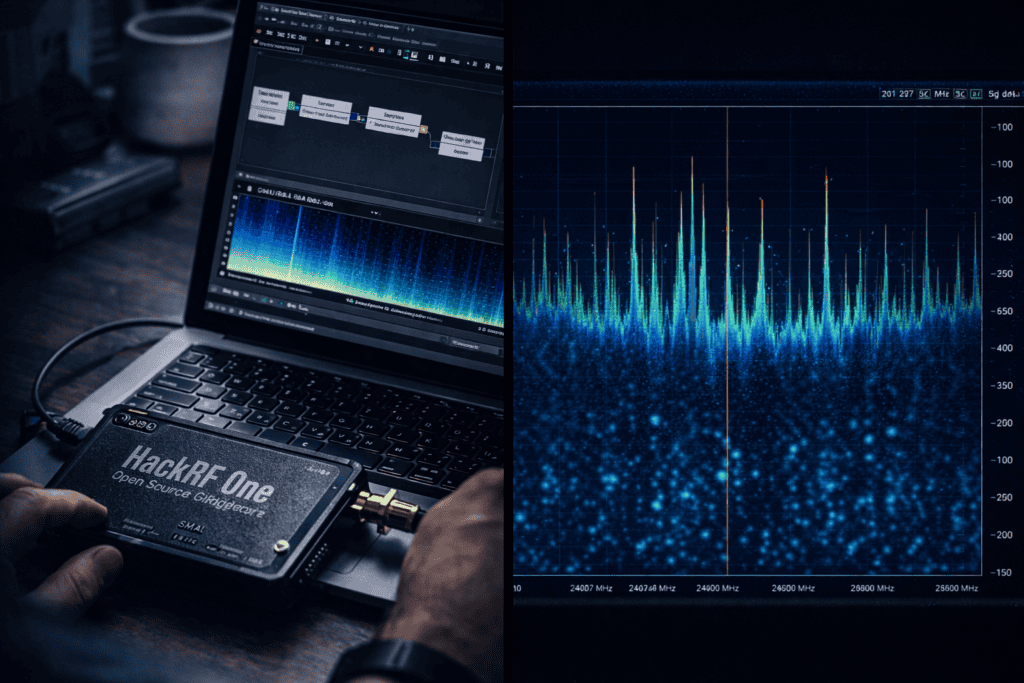
The HackRF One sits around $450 in 2026, depending on where you source it. That hasn’t changed much since release, which says something about both the hardware market and the device’s positioning.
For comparison: an RTL-SDR costs forty bucks but only receives. A PlutoSDR is $200-ish, transmits, but tops out at 3.8 GHz and has less sample rate headroom. A LimeSDR Mini is competitive but costs about the same and has its own quirks. A bladeRF 2.0 micro xA4 is cleaner and faster but runs closer to $700.
The hackrf one price hasn’t dropped because nothing else occupies exactly the same niche: wideband transmit capability at the lower end of the prosumer range.
Security researchers exploring RF attack surfaces. Red teamers building wireless threat simulations. RF reverse engineers who need transmit for protocol fuzzing or replay attacks. CTF players working on radio challenges. Anyone who needs to transmit below 6 GHz without justifying a capital equipment purchase.
It’s not for precision work. It’s not for production deployments. It’s a research and development tool that happens to be affordable enough for individual practitioners.
That’s rarer than it should be.
Ten years ago, doing what the HackRF does required a USRP or proprietary hardware that cost thousands. The HackRF democratized RF research in ways that actually mattered. It put transmit-capable software defined radio into the hands of researchers who weren’t backed by corporate budgets.
But hardware moves forward. Newer SDRs have better specs, cleaner output, faster interfaces. The HackRF One hasn’t had a major hardware revision since launch. It’s showing its age in benchmarks and absolute performance.
What it hasn’t lost is relevance. Because the combination of frequency range, transmit capability, open source everything, and sub-$500 pricing still doesn’t have a clear successor.

Eight-bit ADC means limited dynamic range. You’ll see quantization noise and reduced sensitivity compared to devices with 12-bit or 14-bit converters. In crowded RF environments — urban areas, near broadcast towers, anywhere with strong signals — you’ll notice.
Transmit power is anemic without external amplification. The onboard amp pushes maybe 15 dBm on a good day. For lab work, that’s sufficient. For field research or realistic attack simulation, you’re adding a PA to the signal chain.
Cooling matters. Push the HackRF hard for extended periods and it gets warm. Not thermal-shutdown warm, but enough that frequency stability suffers. Active cooling helps if you’re doing long captures or continuous transmit.
These aren’t deal-breakers. They’re just the trade-offs you accept at this price point.
If you need wideband transmit for research and don’t have $1,500 to drop on a bladeRF or USRP, yes. If you’re building an RF research capability from scratch and want something that handles both receive and transmit across a useful frequency range, yes. If you’re trying to explore wireless protocol security or build POC exploits for radio-based systems, yes.
If you only need receive, get an RTL-SDR or a used Airspy and save your money. If you need lab-grade performance, this isn’t it. If you’re expecting plug-and-play without learning DSP fundamentals, you’re going to have a frustrating time regardless of which SDR you pick.
The HackRF One in 2026 is exactly what it was in 2014: a capable, affordable, open source radio that prioritizes access over perfection. The hardware ecosystem has grown around it, but nothing has fundamentally replaced what it offers. It’s not the best at anything specific, but it’s good enough at everything that matters for the price point.
That’s harder to achieve than it sounds.
The HackRF One isn’t cutting-edge hardware anymore. It’s also still one of the most useful SDRs you can get for wireless security research under $500. The specs haven’t changed, but the context has — and it holds up better than it probably should.
If you’re serious about RF security work, you’ll eventually want more specialized tools. But as the first SDR in your toolkit, or as the transmit-capable backup to a cleaner receive-only device, the hackrf one still makes sense. It’s the platform people learned on, the one that shows up in research write-ups and threat modeling frameworks, the one that’s been replicated and forked and modded because the designs are out there for anyone to build on.
That kind of longevity in the hardware space doesn’t happen by accident. If you’re building out your research capability and need something that transmits across a ridiculous frequency range without requiring grant funding, see what we carry. Just know what you’re getting into.

