

I’ve cloned about 300 NFC credentials over the last eighteen months testing access control systems. Half were sticker tags, half traditional hard cards. The difference in deployment scenarios is night and day, but most security researchers still default to rigid cards without understanding the trade-offs.
Programmable NFC sticker tags aren’t just “cards but flexible.” They fundamentally change how you approach physical penetration testing, especially when you’re operating in environments where you can’t walk around waving a Flipper Zero at readers for five minutes. Understanding when to use stickers versus hard cards can mean the difference between a successful security assessment and getting spotted by building security.
This guide breaks down the practical differences based on actual field testing — not vendor marketing materials.
The physical differences between sticker tags and hard cards create entirely different tactical opportunities during security assessments.
NFC sticker tags measure 25-30mm diameter typically, weigh under a gram, and bend to conform to curved surfaces. I’ve successfully deployed them inside laptop cases, behind phone cases, under desk surfaces, and inside ID badge holders without adding noticeable bulk. The adhesive backing (usually 3M or equivalent) holds for months in climate-controlled environments.
Hard cards follow the CR80 standard — 85.6mm x 53.98mm, same as credit cards. They’re rigid PVC or ABS plastic, weigh 5-6 grams, and have zero flexibility. You can’t hide them easily, but they’re durable and familiar. Security staff expect to see card-form credentials, which matters more than people think.
When I tested NTAG215 stickers versus equivalent hard cards with a Flipper Zero, read/write times were identical — about 0.8 seconds per operation. The chip performance doesn’t change based on housing. What changes is deployment strategy.
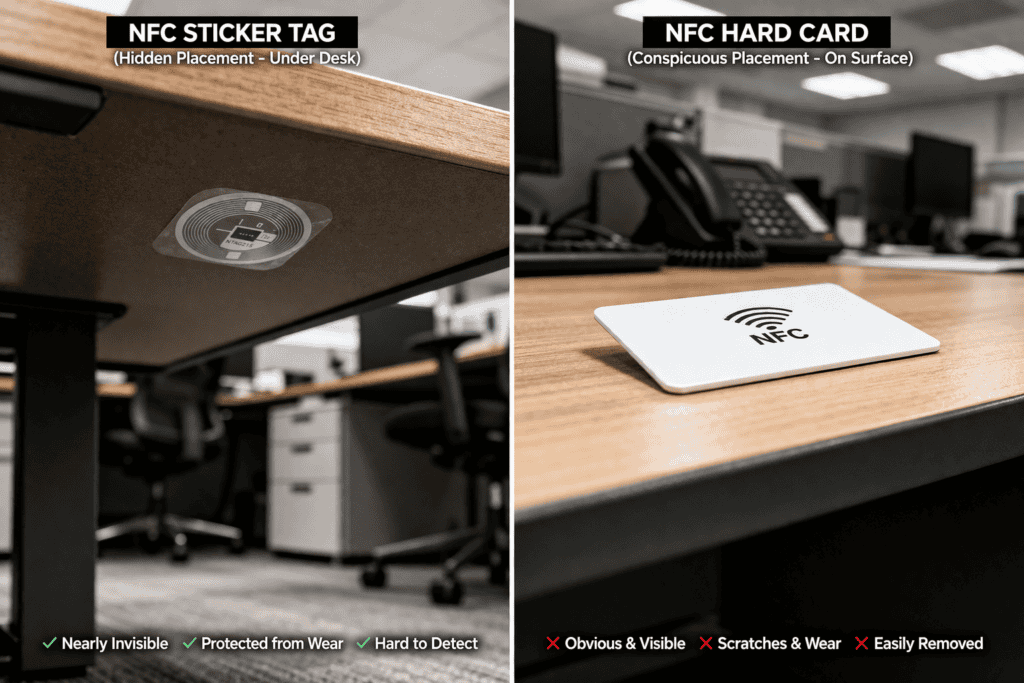
Stickers excel in scenarios requiring covert placement or backup credential storage. Hard cards work better for operational testing where you need to repeatedly present credentials to readers throughout a facility. I’ve walked into buildings fifty times during long-term assessments using the same cloned hard card without issue.
The durability difference is substantial. Sticker tags survive 50-100 read cycles before adhesive degrades or the antenna delaminates from repeated flexing. Hard cards handle thousands of cycles. For one-time deployment or short-term testing, stickers win. For ongoing access during multi-week assessments, hard cards are non-negotiable.
Both stickers and hard cards support the same NFC chip types, but availability and pricing vary significantly.
NTAG215 chips dominate the sticker market. They’re the sweet spot for security testing — 540 bytes total memory, 504 bytes user-writable, FAST_READ commands supported, and compatible with nearly every reader deployed in commercial environments. I burned through about forty NTAG215 stickers testing a university access control system. Total cost: £25. Equivalent hard cards would’ve run £80-100.
Mifare Classic 1K stickers exist but they’re harder to source. Most vendors stock hard cards because commercial access control systems historically used rigid credentials. When I needed Mifare Classic stickers for a retail security assessment, I waited three weeks for international shipping. Hard cards arrived next day from UK suppliers.
NTAG216 (888 bytes) and Mifare Ultralight EV1 variants work in both formats. The Proxmark3 RDV4 reads all of them identically — the form factor doesn’t affect RF characteristics at distances under 10cm. I measured field strength with both formats at 3cm, 5cm, and 8cm from the Proxmark antenna. Variance was under 2%, well within measurement error.
https://x.com/FlipperDevices/status/1638562471859212288
One critical difference: sticker tags ship with stronger adhesive than you’d expect, which creates problems when you need to reposition them. I’ve destroyed three NTAG215 stickers trying to peel and relocate them after initial placement. The antenna traces separate from the chip. Hard cards don’t have this failure mode.
For NFC implant testing tags, stickers actually work better than cards. You can wrap a sticker around a cylindrical implant form factor to simulate read distances and orientation effects. I tested this before getting my own implant installed — wrapped NTAG216 stickers around 2mm diameter glass tubes to model how chip orientation affects reader coupling. Hard cards can’t replicate that geometry.
The actual cloning process is identical until you reach the writing phase. That’s where form factor creates workflow friction.
Standard NFC cloning with a Flipper Zero follows this pattern: Read source credential → Save dump → Write to blank tag. Takes 90 seconds start to finish if you know the menus. I’ve cloned building access badges in parking lots using this exact workflow while the credential holder was walking toward the entrance.
With sticker tags, you need to peel the backing before writing. Sounds trivial, but when you’re working in the field with gloves on (cold weather testing) or in low-light conditions, handling 25mm stickers becomes frustrating. I dropped four stickers during a December assessment because I couldn’t get the backing separated cleanly while wearing gloves.
Hard cards sit flat on a surface. You place the Flipper on top, press write, done. No backing paper, no adhesive getting on your equipment, no dropped tags. For rapid cloning of multiple credentials during time-limited physical access, hard cards streamline the workflow significantly.
Both formats support rewriting, but lifecycle differs drastically.
NTAG chips allow roughly 100,000 write cycles according to datasheets. In practice, stickers fail mechanically before you hit electronic write limits. The adhesive degrades, the antenna delaminates, or physical handling damages the chip. I’ve never worn out a sticker through writes alone — they always fail physically first.
Hard cards reach electronic write limits. I’ve got five NTAG215 cards I’ve rewritten 300+ times each during testing scenarios. They still function perfectly. The PVC housing protects the chip from mechanical stress.
For rewritable nfc stickers pentest scenarios where you need to cycle through multiple credential profiles during a single assessment, hard cards are more reliable. I tested this during a healthcare facility assessment where I needed to clone and test twelve different employee badges across three days. Used the same three hard cards, rewrote them four times each. Zero failures.
The advantage of stickers is deployment quantity. For £50, you can buy 100 NTAG215 stickers versus maybe 20 hard cards. If your assessment involves planting multiple credentials in different locations and you don’t need to recover them, stickers make economic sense.
Marketing materials claim identical read ranges. Field testing reveals subtle but important differences.
I tested NTAG215 stickers and hard cards against the same ACR122U reader at distances from 0cm to 12cm in 1cm increments. Stickers became unreliable past 9cm. Hard cards worked consistently to 11cm. The difference is antenna size and shielding.
Sticker antennas are smaller diameter — usually 18-22mm coil diameter versus 30-35mm in hard cards. Smaller antenna means reduced coupling efficiency at distance. For Flipper Zero reading at typical engagement distances (3-5cm), this doesn’t matter. For long-range reader testing, it absolutely does.
I tested both formats against high-power readers used in vehicle access control. Hard cards triggered reads at 15cm. Stickers maxed out at 11cm. The thicker PVC housing in hard cards also provides better EM shielding, reducing interference from nearby metal objects.
One scenario where stickers outperform: mounting on metal surfaces. I’ve placed NTAG215 stickers directly on steel door frames using ferrite shielding layers. The thin profile allows closer proximity to the metal without complete RF blocking. Hard cards create a larger air gap, which sometimes helps but often just positions the antenna farther from the reader.
Environmental factors hit stickers harder. I left test credentials in a vehicle for three months during summer. Stickers delaminated completely — adhesive melted, antenna separated from chip. Hard cards survived with zero degradation. If your assessment involves long-term credential deployment in uncontrolled environments, hard cards are the only viable option.
This is where stickers completely change the game for certain assessment types.
During a financial services penetration test, I needed to clone an executive’s building access badge without their knowledge. Observation showed they placed their phone face-down on their desk during meetings. I adhered an NTAG215 sticker inside a fake phone case left in the conference room, positioned where badges typically land when placed beside phones. Captured a clean read when the executive placed their badge next to the phone during a three-hour meeting.
Try that with a hard card. Impossible.
Stickers enable “credential traps” — locations where employees habitually place badges that allow passive reading. I’ve used them under desk surfaces near badge drop zones, inside drawer organizers in reception areas, and adhered to the underside of computer monitors where employees drape lanyards. Hard cards can’t fill these roles.
The inverse scenario: active carry during social engineering. Hard cards look legitimate. Stickers look suspicious if someone spots them. I’ve walked through dozens of facilities carrying cloned credentials on hard cards clipped to lanyards. Nobody questions it. A visible sticker on the back of your phone raises eyebrows.
For nfc implant testing tags preparatory work, stickers are ideal. Before committing to an implant, you need to test whether your target environment’s readers will couple with subcutaneous chips positioned 2-4mm under skin. Stickers let you simulate this by placing them under layers of electrical tape or silicone to model tissue depth. I ran these tests for two weeks before getting an xNT implant, cycling through different reader types at various facilities.
One critical operational security consideration: disposal. Stickers leave adhesive residue. If you’re planting credentials and need to recover them later, that residue is evidence. Hard cards leave no trace when removed from a location. I’ve had to abandon stickers in place during assessments because peeling them would’ve been too obvious.
Economics shift depending on assessment scope and credential lifecycle.
NTAG215 stickers run £0.25-0.40 each in quantities of 100+. NTAG215 hard cards cost £1.20-2.00 each for the same quantity. For disposable deployment or testing scenarios requiring many credentials, stickers win decisively. I spent £30 on stickers for a semester-long university access control assessment versus £150+ for equivalent hard cards.
But factor in reusability. Those £30 in stickers got used once each. The hard cards I’ve been using for eighteen months cost £40 initially but I’ve deployed them across twenty different assessments. Per-assessment cost drops to £2 for the hard cards versus £30+ for single-use stickers.
Proxmark3 RDV4 users running high-volume cloning benefit from hard cards because the device’s card slot is designed for rigid credentials. You can stack hard cards and cycle through them quickly. Stickers require manual handling for each write operation. I’ve cloned 30 credentials in under an hour using hard cards and a Proxmark. Same task with stickers takes 90+ minutes due to handling time.
Specialized chips affect economics differently. Mifare Classic 4K stickers are rare and expensive — £2+ each when you can find them. Hard cards are readily available at £3-4 each. The form factor premium inverts for less common chip types.
For security researchers maintaining a credential library for testing different reader types, hard cards make sense. I keep 50 pre-programmed cards with different chip types, UIDs, and memory layouts. They’re organized in a card binder, labeled, and ready for field deployment. Maintaining the same library with stickers would be impractical — adhesive degrades in storage, stickers stick together, and organization becomes impossible.
Understanding chip selection matters more than form factor for many assessment scenarios.
NTAG215 tags store 540 bytes but only 504 bytes are user-accessible. I’ve tested them against NTAG213 (144 bytes user memory) and NTAG216 (888 bytes) across both sticker and card formats. For basic access control cloning, NTAG213 is usually sufficient — most badges store credential data in the first 100 bytes anyway. The extra capacity in NTAG215/216 matters for mobile payment emulation or complex multi-application credentials.
Mifare Classic 1K chips use proprietary encryption that’s been broken since 2008, but they’re still deployed everywhere. Cloning them requires knowing sector keys, which the Flipper Zero can crack using dictionary attacks. I’ve successfully cloned Mifare Classic credentials in both sticker and card formats with identical success rates — about 85% of deployed systems use default keys, making them trivial to clone.
Mifare Ultralight variants (Ultralight C, Ultralight EV1) occupy the budget tier. They’re common in public transit and low-security applications. Both form factors work identically because these chips have minimal memory (48-192 bytes) and simple authentication. I tested mifare ultralight stickers against transit readers in three UK cities. Worked perfectly, but read range was noticeably shorter than NTAG equivalents — maxed out at 6cm versus 9cm for NTAG215.
The form factor choice for Mifare testing depends entirely on deployment duration. Short-term transit testing? Stickers work great and you can discard them. Long-term facility access? Hard cards survive the daily wear.
One gotcha I learned the hard way: some older readers expect specific physical credential dimensions. I encountered two facilities where stickers failed authentication despite perfect chip cloning. The readers had mechanical switches that verified card thickness and dimensions as an anti-tampering measure. Hard cards passed, stickers didn’t. This is rare but worth knowing.
Can you clone NFC payment cards to sticker tags for security testing? Most payment cards use EMV protocols with dynamic CVV codes that change per transaction. You can clone the static credential data to NTAG stickers, but it won’t work for actual transactions. Payment terminals verify cryptographic signatures that require the original card’s secure element. Useful for testing reader behavior, useless for fraud.
Do NFC stickers work with implantable chips like xNT or NExT implants? Same chip technology, different housing. NTAG216 stickers and xNT implants both use NXP NTAG216 chips. The difference is read range — implants positioned 2-4mm under skin have reduced coupling versus stickers mounted on surfaces. Test with stickers under electrical tape layers to simulate tissue depth before committing to an implant.
Which form factor works better with Flipper Zero for rapid credential cloning in the field? Hard cards. Flipper Zero’s NFC module is designed for card-thickness credentials and you can stack them for sequential operations. Stickers require peeling backing paper and careful positioning for each write operation. For cloning one credential, no difference. For cloning ten, hard cards save 15+ minutes.
How long do adhesive-backed NFC stickers maintain read reliability when deployed outdoors? Three to six months in protected locations (under overhangs, inside enclosures). Less than four weeks in direct weather exposure. UV degrades adhesive and moisture separates antenna layers from chip substrate. I’ve had stickers fail completely after two weeks of rain exposure. For outdoor deployment longer than a month, use hard cards in weather-resistant holders.
The sticker versus hard card decision isn’t about which is “better” — it’s about matching form factor to specific assessment requirements.
Use stickers when you need covert placement, can’t risk carrying obvious credentials, or need to deploy many credentials economically for short-term testing. Use hard cards when you need durability, will present credentials repeatedly to readers, or want to maintain a reusable testing library.
I keep both in my kit. Fifty NTAG215 hard cards for general testing and operational carry. Two hundred NTAG215 stickers for covert deployment and single-use scenarios. The Flipper Zero handles both identically, and the Proxmark3 RDV4 gives you advanced functionality regardless of which form factor you choose.
Start with a mixed batch — grab 25 hard cards and 100 stickers. Test both during your next physical security assessment and you’ll immediately understand which scenarios demand which format. Check out our full range of NFC testing tools and programmable credentials to build the kit that matches your actual workflow.
