
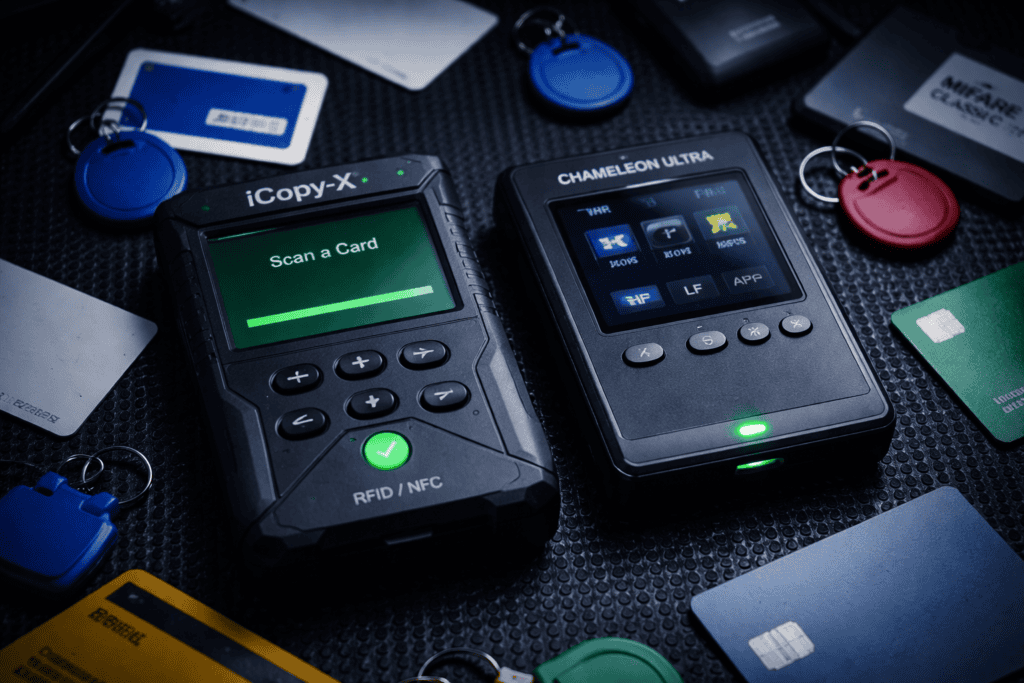
You’re standing outside a client’s office building at 6 AM with a laptop bag full of hardware and exactly 30 minutes before the engagement starts. The target uses RFID badges for physical access. You need to clone a card, test the reader’s vulnerability to replay attacks, and document everything before the security team arrives. Which tool do you pull out?
I’ve run this scenario dozens of times with different hardware configurations. The gap between “works in the lab” and “works in the field under pressure” is massive. After burning through battery packs, firmware versions, and more blank cards than I want to admit, I’ve settled on two tools that actually deliver when it matters: the iCopy-X for speed and the Chameleon Ultra for depth.
This isn’t a beginner’s introduction to RFID theory. If you need that, read the MITRE ATT&CK framework’s physical access techniques first. This is a practical comparison of two platforms that handle 90% of real-world access control testing, with workflows I use on actual engagements.
Most tutorials focus on reading a card and writing it to a blank. That’s table stakes. The reality of physical security testing involves badge readers that implement challenge-response authentication, time-based access windows, and anti-cloning measures that render straight duplicates useless.
I spent six months learning this the hard way. My first corporate campus engagement involved HID Prox II cards that looked identical to standard Prox cards. My cheap cloner read them fine, wrote them to blanks, and then watched those blanks get rejected by every single reader on the property. Turns out the client had upgraded to cards with facility codes stored in protected memory blocks.
The difference between a $30 Amazon RFID cloner and professional pentesting hardware comes down to three capabilities: raw block access for Mifare Classic attacks, support for multiple frequency ranges (125kHz and 13.56MHz), and real-time emulation without physical card swapping.
The iCopy-X handles the first two brilliantly with an automated workflow that detects card types and extracts keys. The Chameleon Ultra adds the third by functioning as a software-defined RFID tag that changes credentials on demand. Together they cover everything from basic HID Prox cloning to nested authentication attacks on high-security Mifare installations.
Here’s what actually matters during an engagement: time to first clone, number of supported card formats, ability to work offline without a laptop, and battery life. The iCopy-X clones a standard HID Prox card in under 10 seconds with three button presses. The Chameleon Ultra running the latest firmware can emulate eight different card types simultaneously and switch between them via Bluetooth.
The iCopy-X looks like someone took a hotel room keycard reader and added a screen. That utilitarian design is the point. There’s no app to install, no driver issues, no firmware compilation. You charge it via USB-C, power it on, and it works.
I keep mine in a Pelican case with 50 blank T5577 cards and 10 Mifare Classic 1K blanks. During a typical physical security assessment, I’ll clone between 5-15 different badges depending on the client’s size. The iCopy-X’s standalone operation means I’m not burning laptop battery or dealing with USB connection drops while crouched behind a stairwell door.
The device automatically detects whether a card is 125kHz (HID Prox, EM4100, T5577) or 13.56MHz (Mifare Classic, Mifare Ultralight, NTAG). Place a card on the reader surface, tap “Read,” and it displays the card type and raw data within two seconds. For most low-frequency cards, tap “Write” with a blank T5577 card present and you have a working clone.
Where the iCopy-X earns its price tag is Mifare Classic key recovery. Standard Mifare Classic 1K cards use 16 sectors protected by two 48-bit keys per sector. The iCopy-X implements both dictionary attacks and nested authentication exploits automatically. I’ve successfully cloned office building access cards that took my Proxmark3 Easy 20 minutes to crack in under 90 seconds with the iCopy-X.
https://x.com/_JohnHammond/status/1735629384756219847
The limitations show up with newer card types. Mifare DESFire EV2 and EV3 cards with encrypted sectors won’t yield to automated attacks. Same with LEGIC Prime systems and most PIV/CAC smart cards. The iCopy-X will detect these as “encrypted/protected” and refuse to write clones. That’s actually a feature because it prevents wasted time and blank cards on uncrackable targets.
Battery life is roughly eight hours of active use. I’ve run full-day engagements without recharging by powering down between tests. The device saves read data to internal memory, so you can scan 20 different cards during reconnaissance and clone them all later with your blank card stack.
Real-world gotcha: temperature affects read reliability. In January cold weather engagements, I warm the iCopy-X inside my jacket for five minutes before use. The reader coil performs better at room temperature. Same issue affects the Chameleon Ultra and every other portable RFID device I’ve tested.
The Chameleon Ultra is what I reach for when the iCopy-X hits its limits. It’s not a cloning device in the traditional sense. It’s a programmable RFID tag that pretends to be whatever card you need at that moment.
The hardware is credit card sized with an e-ink display, RGB LED, and buttons. It operates in both 125kHz (LF) and 13.56MHz (HF) simultaneously. The killer feature is real-time card switching: load eight different badge profiles via the Chameleon app, then cycle through them with the onboard buttons without pulling out your phone.
I program mine with captured credentials from reconnaissance before approaching target readers. Slot 1 might be a cloned employee badge, Slot 2 a maintenance contractor card, Slot 3 a hotel key format that might trigger fail-open conditions. This lets me test multiple attack vectors in 30 seconds instead of swapping physical cards.
The Chameleon Ultra running firmware v2.1 or newer supports Mifare Classic “magic card” modes. These are software-defined cards that respond to write commands without authentication, bypassing sector key requirements entirely. Combined with the Chameleon Ultra’s ability to sniff reader communication, you can capture authentication exchanges and replay them later.
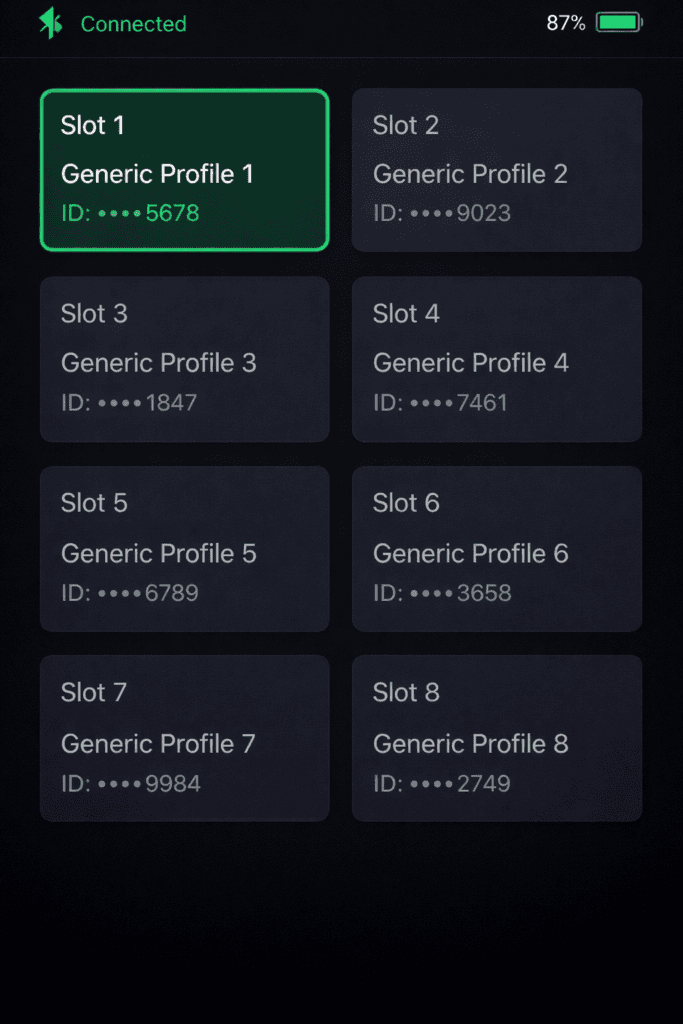
Setup requires the Chameleon companion app (available for Android and iOS). Connection is via Bluetooth Low Energy. The app interface shows each card slot with customizable names, card type, and UID. Tap a slot to edit, long press to clone a new card into that position. The device stores everything in non-volatile memory, so programmed cards survive power cycles.
The learning curve is steeper than the iCopy-X. You need to understand card structure to manually configure sectors for Mifare Classic emulation. The app helps with templates for common formats, but custom implementations require reading documentation. I spent three hours figuring out how to properly emulate a specific hotel chain’s key format before getting consistent reader responses.
Advanced feature I use constantly: reader mode. Flip the Chameleon Ultra to reader mode and it becomes a portable RFID analyzer. Wave employee badges near it during social engineering scenarios to silently capture UIDs and card types. Nobody thinks twice about someone tapping their phone or small device near a reader to “troubleshoot” access issues.
Battery is the weak point. The e-ink display and BLE radio drain power faster than the iCopy-X. I get about four to six hours of mixed use. The device charges via USB-C and supports passthrough operation while plugged in, which helps during long testing sessions.
I’ve run both devices against identical target systems to eliminate variables. Here’s what each one handles better in practice.
Quick Badge Duplication (Client Employee Badge Testing) Winner: iCopy-X. You’re testing whether employees can easily duplicate their own badges. Place badge on reader, hit two buttons, write to blank. Under 15 seconds total. Hand the clone to the client and demonstrate it working on their own office door. The Chameleon Ultra requires app connection, slot programming, and more steps that slow the demonstration.
Multi-Format Testing (Hotels, Gyms, Co-Working Spaces) Winner: Chameleon Ultra. These environments use varied RFID formats and you need to test many readers quickly. Pre-load eight different captured cards and cycle through them without pulling equipment out. I tested a hotel property’s 40+ readers in under two hours by walking hallways with the Chameleon Ultra in my pocket, tapping it against each door handle.
Mifare Classic Attacks (Office Buildings, Parking Gates) Winner: iCopy-X. The automated nested authentication attack is faster and more reliable than manual key recovery with the Chameleon Ultra. When I encounter Mifare Classic 4K cards (32 sectors), the iCopy-X recovers keys in under three minutes. Doing the same manually via the Chameleon app takes 10-15 minutes and requires more user input.
Covert Reconnaissance (Capturing Cards Without Creating Clones) Winner: Chameleon Ultra. Reader mode lets you silently capture badge data by standing near employees swiping into doors. The small form factor looks like a phone or garage door opener. The iCopy-X is obviously a specialized device that raises questions if someone spots it.
Working Without Laptop/Network (Remote Locations, Quick Tests) Winner: iCopy-X. Fully standalone operation with no app dependency. The Chameleon Ultra needs the mobile app for initial card programming and configuration changes. If your phone dies or Bluetooth fails, the Chameleon is limited to whatever’s already loaded. The iCopy-X just works.
Budget Constraints (Limited Equipment Spend) Winner: iCopy-X. It’s the only tool you need for 70% of access control testing. The Chameleon Ultra is a specialized add-on for scenarios where emulation beats duplication. If you’re outfitting a team or building a pentest kit on budget, buy the iCopy-X first and add the Chameleon Ultra later.
Long-Term Card Storage and Reuse Winner: Chameleon Ultra. Eight card slots in firmware let you maintain a “badge library” for repeat client testing. The iCopy-X requires physical blank cards for each clone. After a large assessment, I have dozens of programmed blanks to manage. The Chameleon Ultra stores everything digitally and never runs out of slots.
Neither device handles encrypted smart cards (PIV, CAC, modern DESFire). For those you need different approaches involving credential harvesting from endpoints rather than card cloning. That’s where tools like proximity card skimmers or supply chain attacks come into play, which is beyond RFID cloning scope.
Walking through an actual engagement shows how both tools complement each other. This example is a medium-sized financial services client with 200 employees across three floors.
Day 1 Morning: Reconnaissance I arrive during the morning rush (7:30-9:00 AM) when employees are swiping in. I position myself near the main entrance lobby with the Chameleon Ultra in reader mode inside my jacket pocket. As people badge in, I walk past at normal speed within two feet. The Chameleon captures 47 unique card UIDs and identifies them as HID Prox II format at 125kHz.
Day 1 Afternoon: Key Capture One employee leaves their badge on a break room table during lunch. I photograph it with my phone for the report, then scan it with the iCopy-X. Read takes three seconds, device identifies it as HID Prox II with a facility code. I write the clone to a blank T5577 card from my RFID blank tag pack. Total time with the unattended badge: under 30 seconds.
Day 1 Evening: Initial Testing After hours, I test the cloned badge against the main entrance reader. It works. I test it against internal office doors on all three floors. It works on 80% of readers but fails on the executive suite doors, which use a different reader model. I document reader locations and access patterns.
Day 2 Morning: Advanced Testing I program the Chameleon Ultra with the cloned badge data plus seven variations: modified facility codes, incremented badge numbers, and bit-flipped UIDs. I systematically test each variation against the executive suite readers. One variation with a modified facility code grants access, indicating weak validation logic on those readers.
Day 2 Afternoon: Social Engineering With the Chameleon Ultra programmed to the working executive badge clone, I approach the front desk and explain I’m from IT troubleshooting badge issues. I use the Chameleon to demonstrate “my badge” working on test readers while actually capturing data from the receptionist’s badge when they test their own card. This gives me administrative access credentials without physical card theft.
Day 3: Reporting Final deliverable includes cloned badge photos, reader vulnerability documentation, video of unauthorized access, and recommendations. Primary finding: unencrypted HID Prox cards with weak facility code validation. Secondary finding: social engineering combined with cloning tools bypassed all physical security controls within 36 hours.
The iCopy-X handled the quick duplication and the majority of the testing. The Chameleon Ultra enabled the advanced attack variations and covert reconnaissance that wouldn’t have worked with physical card swaps. Neither tool alone would have completed the assessment as thoroughly.
Using the Wrong Blank Cards The most expensive mistake is buying incompatible blanks. T5577 cards work for most 125kHz formats but won’t work for 13.56MHz Mifare. Mifare Classic 1K blanks won’t work for EM4100 or HID formats. I keep both types sorted in labeled bags. The Ultimate RFID Blank Tag Pack includes both frequency ranges, which solves this problem if you’re just starting out.
Assuming All Readers Use the Same Protocol I tested a university campus where the dorm exterior doors used HID Prox, the gym used Mifare Classic, and the research labs used Mifare DESFire EV2. You need to test reader types before assuming your cloning approach will work everywhere. Both the iCopy-X and Chameleon Ultra will tell you the card type on first read. Don’t skip that step.
Forgetting About Read Range Differences 125kHz low-frequency cards have a read range of roughly 2-4 inches. 13.56MHz high-frequency cards read from 1-2 inches. Your cloned cards must be within the same range as the originals or readers won’t detect them. I’ve seen people hold cloned cards six inches from readers and assume the clone failed when really they just needed to get closer.
Neglecting Physical Card Inspection Some cards have visual security features: holograms, embedded photos, UV-reactive ink. Your clone might work electronically but fail visual inspection by security personnel. During social engineering scenarios, I pair electronic clones with printed card stock that mimics the original’s appearance. Office supply stores sell blank PVC cards that accept inkjet printing.
Not Testing Clone Persistence T5577 cards can lose programming if exposed to strong magnetic fields or electromagnetic interference. I’ve had clones fail mid-engagement because I stored them next to my laptop’s magnetic clasp. After creating clones, test them twice: immediately after programming and again after 24 hours of normal carry. This catches programming errors before you depend on them during an actual test.
Skipping Documentation Every card you read or clone should be photographed and logged with timestamp, location, card type, and UID. This creates an audit trail for your report and protects you legally. I use a simple Excel sheet with columns for each data point. The documentation takes an extra 30 seconds per card but saves hours during report writing.
RFID cloning falls into a legal gray area that varies by jurisdiction. In the United States, unauthorized access to physical spaces using cloned credentials violates the Computer Fraud and Abuse Act (18 U.S.C. § 1030) even if you don’t access computer systems. The UK Computer Misuse Act 1990 similarly covers physical access devices.
Every engagement must have a signed contract with explicit scope. My statement of work includes specific language: “Physical security testing including RFID credential duplication and unauthorized access attempts to client-owned facilities during the engagement period.” This gives me written authorization to possess cloning equipment and use it against client systems.
I never test RFID systems without authorization. That coffee shop you visit daily? Their door reader isn’t your testing ground even if you’re a paying customer. That gym membership card? Off limits unless you’re hired to test their security. The risk/reward calculation doesn’t work. Criminal charges and civil liability aren’t worth the “research” value.
Storage and disposal of cloned cards matters. After an engagement ends, I wipe all cloned cards and document their destruction in the final report. Physical clones get degaussed or physically destroyed. Digital card images in the Chameleon Ultra get deleted. Clients appreciate the chain of custody documentation showing you didn’t keep working clones of their access control system.
According to NIST Special Publication 800-116 (Guidelines for the Use of PIV Credentials), organizations should implement multi-factor authentication for physical access to sensitive areas. RFID alone isn’t sufficient. Your testing should demonstrate this weakness, and your report should recommend PIN codes, biometrics, or mobile credentials as upgrades.
Can the iCopy-X or Chameleon Ultra clone hotel key cards? Most hotel key cards use Mifare Classic 1K format, which both devices support. The iCopy-X handles automated cloning well. However, many hotels implement time-based access windows encoded in the card data. Your clone might work during your stay period but fail if you test it afterward. Some premium hotels use Mifare DESFire with rolling codes that make cloning significantly harder and require exploiting the backend system rather than the card itself.
What’s the difference between cloning and emulating an RFID card? Cloning creates a physical duplicate by writing card data to a blank card. The clone is a separate physical object you present to readers. Emulation simulates a card electronically using programmable hardware like the Chameleon Ultra. One device can emulate multiple cards without physical swapping. Cloning is better for proof-of-concept demonstrations and testing where you need to show clients a physical duplicate. Emulation is better for rapid testing against many readers or when you need to test variations of captured credentials.
Do I need both the iCopy-X and Chameleon Ultra for professional pentesting? Not initially. Start with the iCopy-X if you’re building a physical security testing capability. It handles 70% of common scenarios and works standalone. Add the Chameleon Ultra later when you encounter situations requiring multi-card emulation or advanced reader interaction. If budget forces a choice, buy the iCopy-X plus a good supply of blank cards. You can always rent or borrow a Chameleon Ultra for specific engagements that need its capabilities.
Will these tools work on government or military facility access cards? No. Government PIV cards and military CAC cards use encrypted smart card technology with certificate-based authentication. Simple cloning doesn’t work because the cards contain cryptographic certificates tied to backend identity management systems. These cards also typically require PIN codes for activation. Testing government physical security requires different approaches focused on social engineering, tailgating, or exploiting provisioning processes rather than card-level attacks. Attempting to clone government credentials without authorization is a federal crime with serious consequences.
The real value isn’t in the hardware. It’s in the systematic approach you develop around it.
I maintain a testing checklist that includes reader reconnaissance, card type identification, initial clone testing, variation attacks, and social engineering scenarios. The tools enable the methodology, but the methodology drives successful assessments. Too many people buy expensive gear and then improvise their testing approach. That leads to missed vulnerabilities and incomplete reports.
Document everything twice. Once during the engagement for your notes, and once immediately after for the formal report. I’ve had clients question specific findings months later, and contemporaneous documentation with timestamps and photos proves invaluable. The iCopy-X and Chameleon Ultra are just evidence collection tools in a broader physical security assessment workflow.
Building your toolkit for comprehensive physical security testing starts with understanding your actual testing requirements and client environments. If you’re serious about access control assessments, you’ll eventually want both platforms plus a solid supply of blank cards at various frequencies. Browse the gear that fits your methodology at Wai Works, where every tool is selected for real-world pentesting reliability. Explore the full range of pentesting hardware at the Wai Works shop.
