Most security researchers carry a $30 USB dongle that sees what your eyes can’t every wireless signal between 24MHz and 1.7GHz. I’m talking about the RTL-SDR, and if you’re not using one to audit RF attack surfaces, you’re missing half the vulnerabilities in modern environments. Car key fobs, garage door openers, wireless doorbells, weather stations, tire pressure monitors they all broadcast in clear text or laughably weak encryption, and most pentesters never even look at this layer.
The first time I pointed an RTL-SDR at my own car, I captured the unlock sequence in under three minutes. Not theoretical—actual replay-ready packets. That’s when RF security research stopped being academic for me and became a mandatory skill for any hardware engagement.
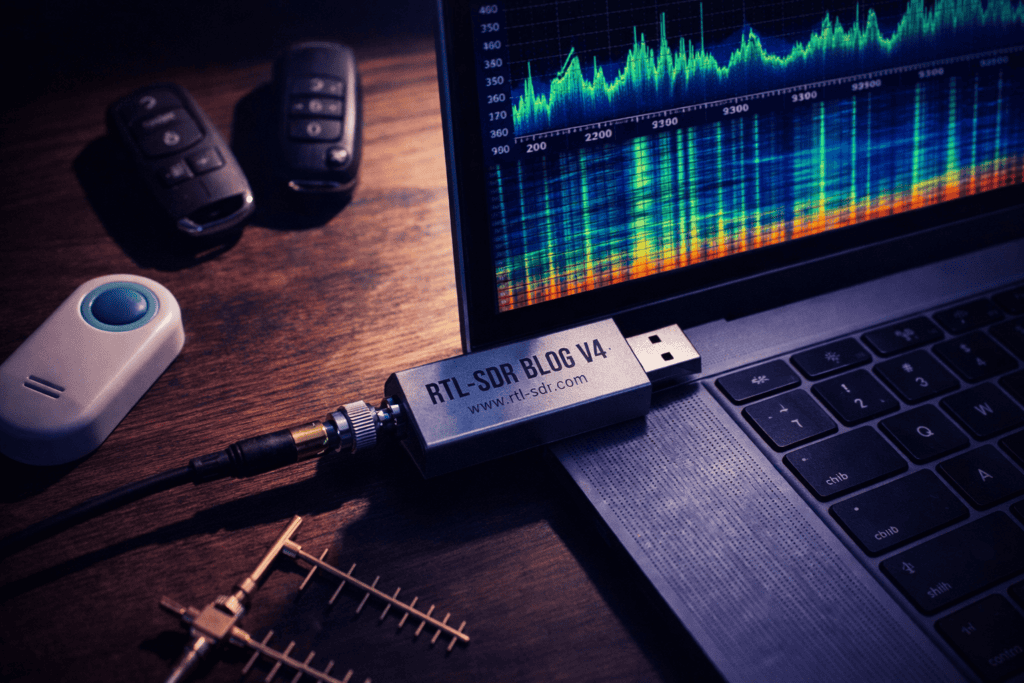
Software Defined Radio flips traditional radio hardware on its head. Instead of fixed-frequency receivers with dedicated demodulators, you’re pushing raw RF data into software where you control everything—frequency, bandwidth, modulation schemes, filters. The RTL-SDR Blog V4 takes this concept and makes it accessible. For the cost of two coffees, you get a receiver that covers VHF, UHF, and portions of L-band.
Traditional spectrum analyzers cost thousands and lock you into vendor software. RTL-SDR works with GNU Radio, Universal Radio Hacker (URH), SDR#, GQRX—every major open-source RF toolkit. When I’m doing security research, I need to move fast. Capture a signal, feed it into URH for analysis, decode the modulation, understand the protocol, then move to exploitation. This workflow costs $30 in hardware.
The V4 specifically improves on earlier RTL2832U designs with better ADC performance, lower phase noise, and bias tee support for powered antennas. You’re looking at improved sensitivity around 20-30dB compared to generic TV tuner dongles. In practical terms, that’s the difference between hearing your neighbor’s wireless doorbell and hearing the one three houses down. Range matters when you’re profiling an environment or doing drive-by RF recon.
The 315MHz and 433MHz Industrial, Scientific, and Medical (ISM) bands are an absolute goldmine for security research. These frequencies don’t require licensing in most jurisdictions, so manufacturers dump everything here—garage doors, car alarms, remote controls, medical alert buttons, weather sensors, smart home devices.
I’ve tested dozens of consumer products in this space. Maybe 10% implement proper rolling codes or challenge-response authentication. The rest? Fixed codes transmitted in ASK (Amplitude Shift Keying) or FSK (Frequency Shift Keying) that you can capture and replay trivially. I’m not talking about sophisticated attacks—you literally record the signal and play it back.
The Ultra-Wideband 700MHz–2700MHz Log Periodic Antenna extends your reach significantly. Stock RTL-SDR antennas are omnidirectional and mediocre. A proper log-periodic gives you directional gain, which helps in two ways: you reduce noise from unwanted signals, and you increase sensitivity toward your target. When I’m hunting for a specific IoT device in a dense RF environment, directionality is everything.
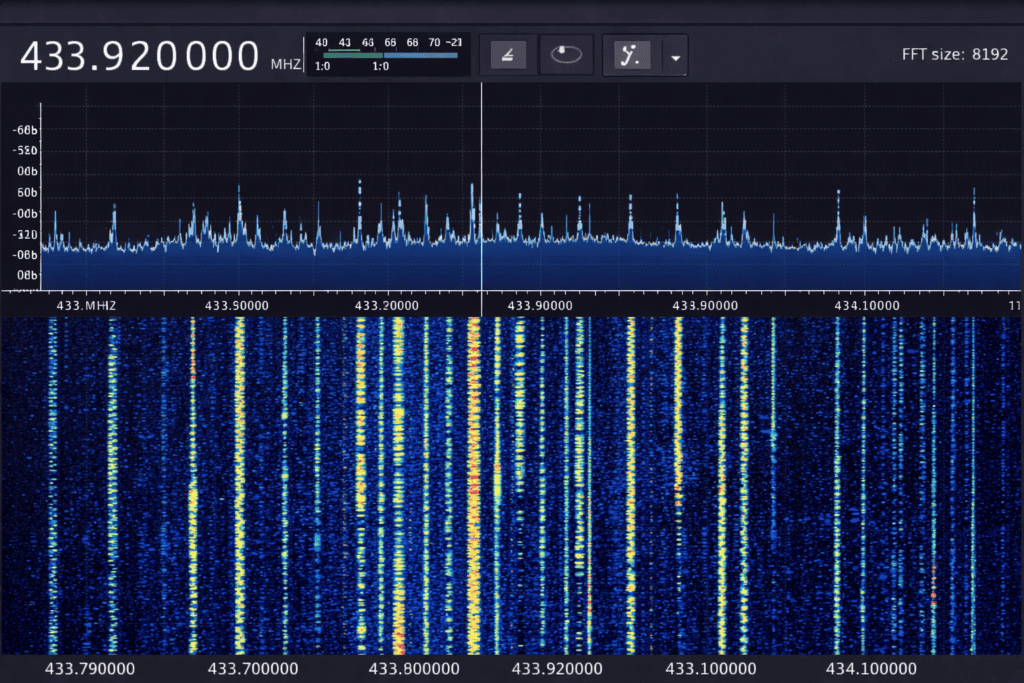
433.92MHz specifically is chaos. Walk through any suburban neighborhood with an RTL-SDR and GQRX running—you’ll see wireless thermometers, tire pressure monitoring systems (TPMS), doorbell buttons, gate controllers, even some older home security systems. Most transmit device IDs in clear text. Some include sensor readings unencrypted. One weather station I tested transmitted its WiFi network name in the packet header. Not the password, thankfully, but still.
First deployment: don’t just plug the dongle into USB and expect magic. The driver situation on Windows is annoying—you need Zadig to replace the default DVB-T driver with WinUSB or libusb. On Linux, you’re golden out of the box if you’ve installed rtl-sdr packages. On macOS, use Homebrew and pray you don’t hit USB3 compatibility issues (spoiler: you will, use a USB2 hub).
Start with SDR# (SDRSharp) on Windows or GQRX on Linux/macOS. These are spectrum analyzers with waterfall displays—visual representations of frequency over time. You’ll see every transmission as it happens. Set your center frequency to 433.92MHz, bandwidth to around 2MHz, and watch. Within minutes you’ll capture something. When you do, record it. SDR# has built-in recording, GQRX outputs to WAV or raw I/Q files.
Once you’ve captured signals, move to Universal Radio Hacker. URH is purpose-built for protocol reverse engineering. Import your recording, and URH will attempt to auto-detect modulation (ASK, FSK, PSK). From there you can decode bits, analyze packet structure, identify preambles, sync words, and payload. I’ve reverse-engineered proprietary wireless protocols in URH that would’ve taken weeks with manual analysis.
GNU Radio is next-level—visual programming for signal processing. You build flowgraphs that define how your SDR receives, filters, demodulates, and decodes signals. The learning curve is steep, but once you understand blocks and signal flow, you can create custom decoders for anything. I built a 315MHz garage door opener decoder in GNU Radio that extracts DIP switch settings from the transmission. Took me a weekend to learn GNU Radio basics and another few hours to build the flowgraph.
Car key fobs operate primarily on 315MHz (North America) and 433.92MHz (Europe, Asia). Older vehicles—pre-2000s—use fixed code systems. You press unlock, the fob transmits the same code every time. Capture it once, replay it forever. Modern vehicles mostly use rolling codes (KeeLoq, HCS protocols) where each transmission increments a counter and uses cryptographic functions to generate new codes.
Here’s what I do: capture multiple unlock sequences from the same fob. If the codes are identical, you’ve got a fixed code system and trivial replay. If they differ, you’re looking at rolling codes. Import into URH and examine bit-level differences. Rolling code systems typically have a fixed portion (device ID, function code) and a variable portion (rolling counter, encrypted payload).
I tested a 2004 Honda Civic fob—pure fixed code. Twenty-four bits transmitted in OOK (On-Off Keying, which is just ASK with 100% modulation depth). Replayed it with a T-Embed CC1101 RF Expansion Module and the car unlocked. No bruteforce, no cryptanalysis, just capture and replay. That’s a fifteen-second attack with $60 in hardware.
Rolling codes are trickier but not bulletproof. KeeLoq has known cryptanalytic weaknesses—side-channel attacks have recovered keys from power analysis. Practically, jamming attacks work better: jam the legitimate signal so the car doesn’t receive it while you capture the code, then replay it later. The car’s counter hasn’t incremented because it never saw the transmission. This is called a rolljam attack, and it works against most consumer rolling code implementations.
Tesla and higher-end manufacturers use challenge-response protocols where the car sends a random challenge and the fob must respond correctly. Much harder to attack without proximity or relay techniques, but those are outside RTL-SDR’s scope—you need active RF transmission hardware for relay attacks.
Wireless sensors are everywhere—temperature monitors, door/window sensors, motion detectors, soil moisture sensors for gardens. Most use ultra-low-power transmitters on 433MHz or 915MHz. Power consumption constraints mean simple modulation and minimal protocol overhead.
I captured a wireless doorbell that transmitted eight bits: four for device ID, four for button ID. That’s it. No encryption, no authentication, no rolling anything. With URH I decoded the transmission in under five minutes, then wrote a Python script using the RFM69 library to transmit arbitrary device IDs. You can ring any doorbell in range by iterating through the sixteen possible device IDs.
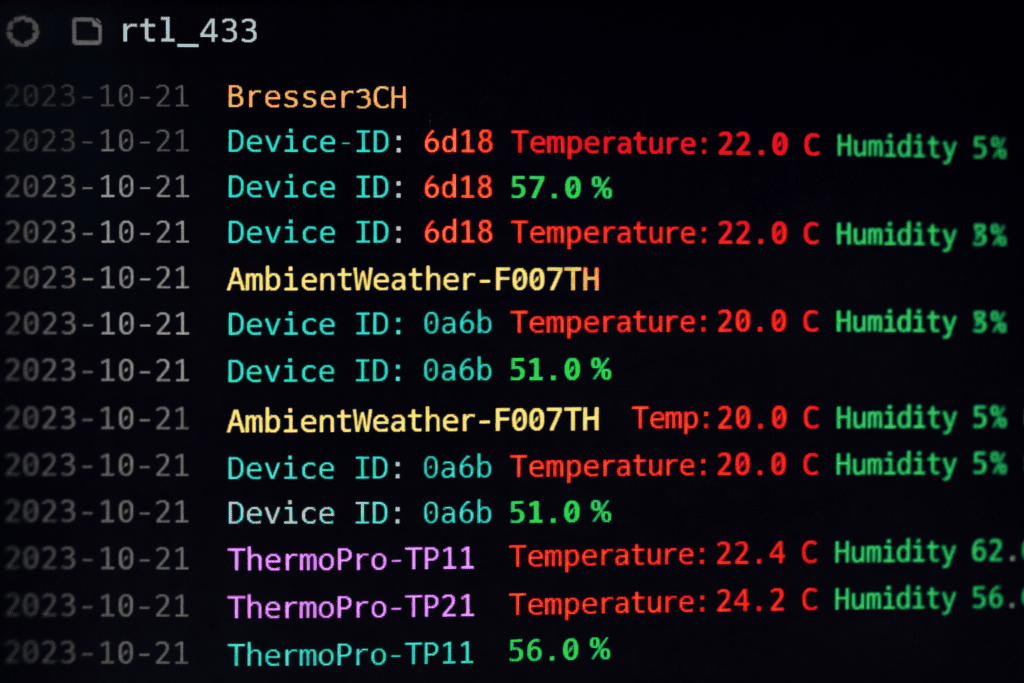
Weather stations are chattier—they transmit temperature, humidity, sometimes barometric pressure every thirty seconds or so. Oregon Scientific and similar brands use well-documented protocols. RTL-SDR combined with rtl_433 (a command-line decoder for dozens of common protocols) gives you instant visibility. Run rtl_433 -f 433920000 -s 1024000 and watch decoded weather data stream to your terminal.
From a security perspective, these devices leak information. You can profile occupancy patterns from door sensor data, detect when someone’s home based on thermostat transmissions, even infer behavior from smart plug usage patterns. Most people don’t realize their wireless sensors are broadcasting to anyone with a $30 dongle.
TPMS sensors broadcast tire pressure and temperature data at 315MHz (North America) or 433MHz (Europe). Each sensor has a unique ID, and they transmit every thirty seconds to a few minutes depending on the system. The data includes sensor ID, pressure reading, temperature, and often battery status.
Security researchers care about TPMS for two reasons: tracking and spoofing. Because sensor IDs are fixed and transmitted constantly, you can track individual vehicles by their TPMS signatures. Park at a chokepoint with an RTL-SDR logging all TPMS IDs, and you’ve got a persistent vehicle tracking system that doesn’t require license plate recognition.
Spoofing is the offensive play. If you can decode the packet structure and checksum algorithm, you can transmit fake TPMS data. I worked on a proof-of-concept that sent low tire pressure warnings to a test vehicle’s dashboard. The system accepted the spoofed packets without question—no authentication, no crypto, just a CRC8 checksum for error detection.
The protocol varies by manufacturer—some use Manchester encoding, others use differential Manchester or PWM. Tools like rtl_433 support multiple TPMS formats out of the box. Run it, drive around for fifteen minutes, and you’ll have sensor IDs and pressure readings for every car you pass.
Fixed-code garage door systems were the norm until the mid-90s. DIP switches inside the remote and receiver set a twelve-bit code—4,096 possible combinations. You could bruteforce that in seconds with modern hardware. Even without bruteforce, capturing one transmission gives you the code.
I tested a residential gate controller still using fixed codes. Captured the open sequence, replayed it a week later—gate opened. The installation was from 2003, and nobody had upgraded the hardware. This is common. Legacy security hardware stays in place for decades because it “still works.”
Modern openers use Security+ or Security+ 2.0 (Chamberlain/LiftMaster), rolling codes with higher bit depth and better crypto. These are harder but not immune. Research presented at DEF CON showed vulnerabilities in Security+ that allowed prediction of future codes. The attack required capturing thousands of codes to extract patterns, but it was feasible.
From a defensive standpoint, if you’re using a garage door opener manufactured before 2011, assume it’s vulnerable to replay. Upgrade to rolling code systems, or better yet, add secondary authentication—require a PIN or biometric alongside the wireless signal.
The T-Embed CC1101 bridges the gap between passive reception and active transmission. RTL-SDR is receive-only—you can capture and analyze but not transmit. The CC1101 is a true transceiver covering 300-348MHz, 387-464MHz, and 779-928MHz.
For security research, you analyze signals with RTL-SDR, decode them in URH, then implement transmission with CC1101. The workflow is: capture with RTL-SDR, reverse engineer protocol structure, write firmware for CC1101 to generate valid packets, transmit and validate against target system.
I built a PoC for a 433MHz remote control socket. Captured the ON and OFF codes with RTL-SDR, loaded them into a CC1101-based device, and could control the socket from across the room. The protocol was absurdly simple—sixteen bits, fixed code. Total development time: ninety minutes including learning the CC1101 library.
The CC1101 also supports packet handling in hardware—it can automatically add preambles, sync words, CRC checksums, and handle whitening. This makes implementing complex protocols much easier than bit-banging everything in software. For rapid prototyping of RF exploits, CC1101 is unbeatable at its price point.
Not all wireless systems sit still on one frequency. Bluetooth, for example, uses frequency hopping spread spectrum (FHSS) across seventy-nine 1MHz channels in the 2.4GHz band. WiFi uses DSSS or OFDM with channel bonding. These techniques resist jamming and interference but also complicate analysis.
RTL-SDR can’t follow frequency hoppers in real time—you’d need specialized hardware like the HackRF or USRP with faster sample rates and wider bandwidth. For security research on hopping systems, you either need to work at the protocol layer (capture during connection setup when devices are on known frequencies) or invest in higher-end SDR hardware.
That said, plenty of security-relevant signals don’t hop. Pagers operate on fixed frequencies. Many IoT devices transmit periodically on single channels. Legacy systems predate spread spectrum entirely. The attack surface accessible with RTL-SDR alone is massive.
When I encounter hopping systems during assessments, I shift strategy—look for downgrade attacks that force devices to simpler modes, or target the pairing/discovery phase when devices are more predictable. Sometimes the best RF attack is to jam the primary band and force failover to a less secure backup protocol.
Receiving signals is legal almost everywhere—you can listen to anything traveling through the air. Transmitting is where laws kick in. In most jurisdictions, transmitting on frequencies you’re not licensed for is illegal. Jamming is illegal everywhere that matters. Interfering with safety-critical systems (aircraft, emergency services, medical devices) gets you federal charges.
For security research, stay in lab environments with shielded rooms or Faraday cages if you’re transmitting. If you’re doing field testing, get explicit written authorization from the asset owner. I’ve been on engagements where we had to coordinate with spectrum regulators because our testing overlapped with licensed services.
Capturing car key fobs in a parking lot is a gray area—you’re passively receiving, but the intent matters. If you’re researching vulnerabilities to disclose responsibly, document everything. If you’re capturing to exploit, that’s unauthorized access in most legal frameworks. Intent and context determine legality.
When I publish research, I follow coordinated disclosure—notify the vendor, give them time to patch, then release findings publicly. For consumer devices without clear vendors (generic Chinese IoT junk), I publish immediately because there’s no one to coordinate with and users deserve to know the risks.
Can RTL-SDR capture cell phone calls or decrypt encrypted communications? No. RTL-SDR can receive LTE/5G signals but they’re encrypted at the baseband level with keys you don’t have. You’d see the transmissions in the spectrum but couldn’t decode content. Older 2G networks had weak crypto (A5/1) that’s been broken, but carriers have mostly shut down 2G. Police/emergency radios are increasingly encrypted too. RTL-SDR shows you what’s transmitting, not necessarily what it says.
What’s the maximum range for capturing signals with RTL-SDR and the log periodic antenna? Depends heavily on frequency, transmitter power, and environment. For typical car key fobs (10mW transmit power), you’re looking at 50-100 meters with the log periodic in open air. Urban environments with RF noise cut that in half. High-power devices like wireless doorbells or TPMS can be received from 200+ meters with good line of sight. Adding an LNA (low noise amplifier) pushes sensitivity another 10-15dB, roughly doubling effective range.
Is it illegal to capture and analyze wireless signals in my neighborhood? Receiving is legal in most countries—signals broadcast into public space have no expectation of privacy under most laws. Transmitting back, jamming, or using intercepted data for unauthorized access crosses legal lines. In the US, the FCC allows reception; the Computer Fraud and Abuse Act (CFAA) covers what you do with that data. UK’s Wireless Telegraphy Act permits reception but criminalizes interception with intent. Document your research, stay in passive mode, and consult local regulations if you’re uncertain.
Can I use RTL-SDR to test my own smart home devices for vulnerabilities? Absolutely, and you should. Set up RTL-SDR with GQRX or rtl_433, scan common IoT frequencies (433MHz, 868MHz, 915MHz depending on region), and see what your devices are broadcasting. You’ll likely find sensor IDs, status updates, maybe even network SSIDs transmitted in clear text. If you discover vulnerabilities, contact the manufacturer through their security disclosure program if they have one, or publish responsibly if they don’t respond within 90 days.
You don’t need a full lab to start RTL-SDR security research—just the dongle, a decent antenna, and curiosity about what’s actually in the RF spectrum around you. The first few captures always surprise people. That “secure” wireless doorbell isn’t. The car you thought had rolling codes doesn’t. The baby monitor broadcasts audio to anyone listening on 2.4GHz.
Start with passive reconnaissance. Map your environment. Identify transmission frequencies, modulation types, repetition patterns. Build a database of device signatures. Then move to active analysis—capture, decode, understand protocol structure. Only after you’ve mastered the technology stack should you consider offensive research with transmission hardware.
If you’re building out a serious RF security toolkit, the RTL-SDR Blog V4 is your foundation. Add the log periodic antenna for range and directionality. When you’re ready for TX capability, the CC1101 board gives you practical replay and injection tools. That’s a complete sub-GHz research platform for about £100.
The invisible spectrum is everywhere, and most of it is hilariously insecure. Whether you’re doing professional security assessments or just curious about what your devices are actually broadcasting, RTL-SDR opens that world. Browse the full range of pentesting hardware at the Wai Works shop.

